

Roasting Shrinkage and Weight Control in Nut Roasting and Packaging Businesses
Flawlessly track moisture loss shrinkage in raw products, salt/sauce consumption, and ziplock pouch inventory with Qolay.App in nut roasting and packaging workshops.
On this page
Don't Let Weight Lost in the Roasting Oven Leave a Gap in Your Cash Register
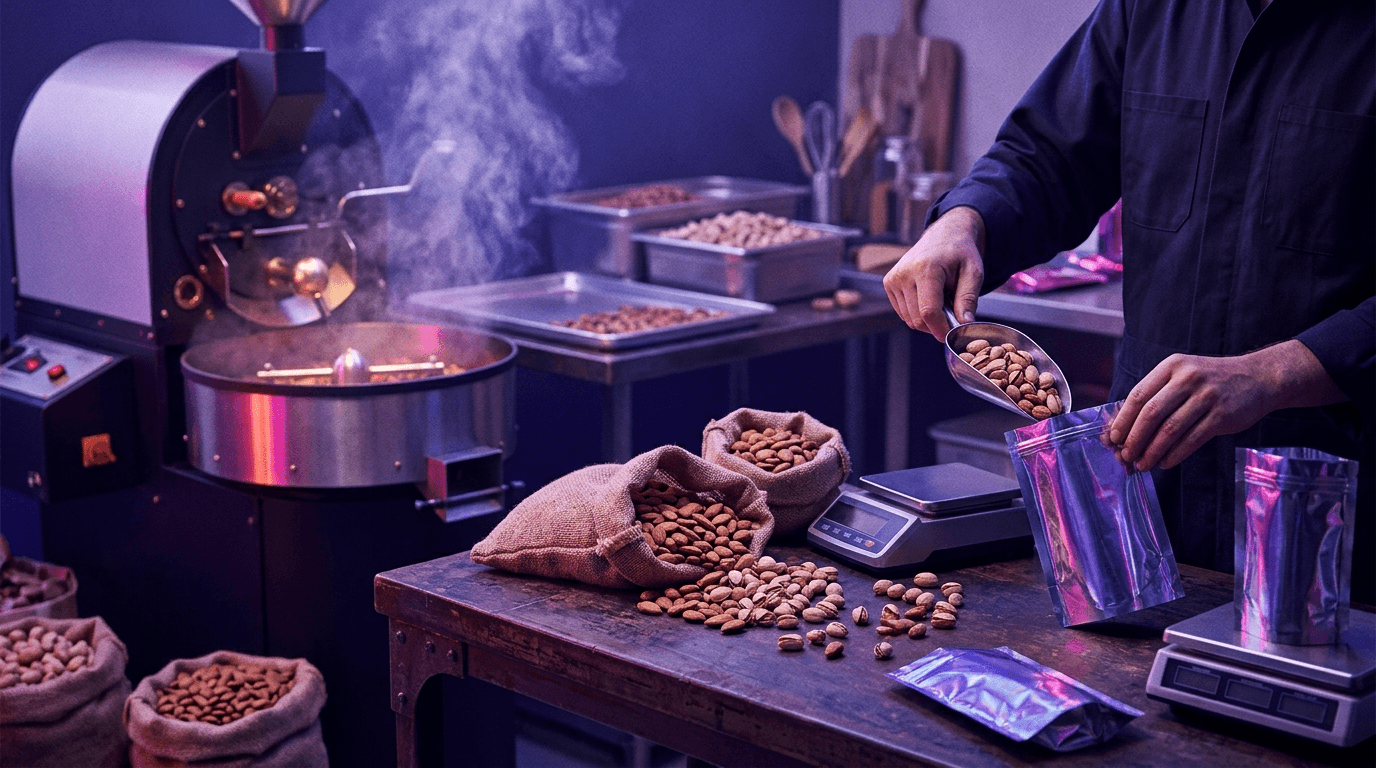
In nut roasting and packaging businesses, products lose weight inside the oven before they even reach the customer. Raw almonds, hazelnuts, cashews, or sunflower seeds lose their natural moisture through evaporation during roasting and go through a broken-and-burnt sorting process. As a result, 54 kg of raw almonds enter the oven, but only 50 kg of ready-to-sell roasted almonds are obtained at the end of the sieve.
If you calculate your costs only based on the net 250 grams inside the package while preparing 250-gram packs, you are giving away the evaporated and sifted 4 kg for free. Moreover, if the zipper doypack bags used during the packaging stage, front and back product labels, oven natural gas, and salt-texture mix are not tracked, your inventory and cash shortages will grow while you think you are making a profit in wholesale or e-commerce channels.
Why Simple Recipe + Separate Waste Entry Instead of Heavy ERP and MRP?
Heavy ERP and MRP software developed for food businesses or nut packaging workshops challenges small and medium-sized enterprises with complex schedule tables, mandatory sub-production tiers, and high installation costs. The structure needed by a business that roasts and quickly packages raw products coming in sacks is to combine the purchase invoice, recipe, roasting waste, and bag stock under a single front-accounting roof.
Qolay.App is a front-accounting platform. In the Production Management module, Web and iOS/Android mobile screens operate with the same simple layout. There is no fixed waste rate box in the recipe, because roasting waste varies from batch to batch depending on the harvest period and moisture rate of the raw product. You keep the net package weight in the recipe, and process the actual moisture and sorting loss in each roasting batch via the Enter Waste window.
Realistic Scenario: Cost of 200 Packs of 250 g Roasted Salted Almonds
Let's assume that 200 packs of 250 g Roasted Salted Almonds (50 kg net packaged product) are produced in a roasting and packaging batch. To obtain this 50 kg net roasted almonds, an 8% (4.00 kg) waste occurred due to moisture evaporation and broken sorting from the raw almonds entering the oven. The calculation of all items is as follows:
| Cost Item (For 200 Packs) | Record Type | Quantity / Calculation | Amount (TL) |
|---|---|---|---|
| Raw Kernel Almonds (Net Package Content) | Component | 200 × 0.25 kg = 50.00 kg × 360 TL | 18,000.00 TL |
| Sea Salt & Texture Mix | Component | 200 × 0.01 kg = 2.00 kg × 50 TL | 100.00 TL |
| Total Raw Material | Subtotal | 18,000 + 100 | 18,100.00 TL |
| Roasting Oven Natural Gas & Electricity | Additional Cost (Service–Rate) | Raw material only (18,100 TL) × 5% | 905.00 TL |
| Roasting & Packaging Batch Labor | Additional Cost (Service–Amount) | Fixed per batch (multiplication disabled) | 795.00 TL |
| 250 g Zipper Doypack Bag + Label | Additional Cost (Stock) | 200 pcs × 9 TL (multiplication enabled) | 1,800.00 TL |
| Roasting Moisture Loss & Broken Sorting | Enter Waste | 4.00 kg × 360 TL (does not enter 5% base) | 1,440.00 TL |
| Total Production Cost | Grand Total | 18,100 + 1,440 + (905 + 795 + 1,800) | 23,040.00 TL |
| Unit Package Cost | 200 Sound Packages | 23,040.00 ÷ 200 | 115.20 TL / package |
If only the 250-gram raw almonds were looked at, the package cost would be thought to be 90 TL. However, when roasting waste (7.20 TL per package), doypack bag and label (9 TL), energy (5% = 905 TL), and labor are added, the real unit cost turns out to be 115.20 TL.
Step-by-Step Roasting and Packaging Tracking with Qolay.App
- 1. Set Up the Recipe (Production → Recipes): If you also roast and sell raw products in bulk, you can first produce the "Roasted Almonds (kg)" semi-finished product and then produce 250 g and 500 g packages. If you only sell packaged goods, it is enough to define a direct package recipe.
- 2. Define Additional Costs: Add the oven natural gas/electricity share as Service–Rate (5%), roasting-packaging master labor as Service–Amount (multiplication disabled), and 250 g Doypack Bag + Label as Stock (multiplication enabled).
- 3. Process Production Entry and Roasting Waste (Production → Production Entries): When packaging is finished, record the 200 packages that came out sound. Enter the 4.00 kg difference between the raw weighing (54 kg) and the roasted net weighing (50 kg) into the Enter Waste window with the note "Roasting moisture loss and sorting".
- 4. Monitor E-Commerce Stock Transfer and Reports (Production → Reports): As soon as the produced 200 packages enter the stock, your marketplace/e-commerce integration automatically sees the new quantity. Thanks to the Waste Report, you can compare the roasting waste rates of different crop batches coming from the supplier for up to 366 days.
5 Common Cost and Stock Mistakes in Nut Businesses
- Not Treating Roasting Moisture Loss Like the Inside of Sacks: An average of 6–12% moisture evaporates in each roasting batch; if Waste Entry is not made, tons of imaginary raw nuts will appear in the warehouse.
- Assuming the Same Bag Price for 250 g, 500 g, and 1 kg Packages: The bag and label of each grammage must be a separate stock card and deducted with its own Stock-typed additional cost.
- Confusing Sack/Ton Purchases with Kilogram Recipes: It is necessary to process kilograms instead of sacks on the purchase invoice to ensure exact compatibility with the recipe unit (kg); there is no unit conversion in v1.
- Writing Salt, Sauce, and Frying Oil as Expenses and Not Including Them in the Recipe: Especially in sauced corn and cashews, oil and spice consumption takes up a significant place; they must be defined as components.
- Delaying Uninvoiced Producer/Wholesaler Purchases: If production is entered before the purchase document is processed, the stock will drop into the negative and the cost that the nighttime FIFO engine will finalize will remain incomplete.
Frequently Asked Questions
How should I set up a recipe if I sell both bulk roasted almonds and 250 g packages?
You first produce the "Roasted Almonds (kg)" semi-finished product and deduct the roasting waste at this stage. Then you select "Roasted Almonds (kg)" as a component in 250 g and 500 g package recipes and tie the bag/label with the Stock additional cost.
Should I enter waste if I separate broken nuts coming out of the sieve for paste or pastry dough?
You only deduct the evaporated moisture loss and the completely wasted burnt/spoiled portion with Enter Waste. You can evaluate sound broken pieces to be used in another product.
Is there a production document given to wholesale customers or presented to accounting?
Yes. You can get a customizable Production Slip PDF document from every production record; Accountants and Read-Only users can also view and print these documents and 4 reports.
Take Every Kilogram and Package Coming Out of the Oven Under Control
The way to maintain profitability in the nut roasting and packaging business is to regularly track roasting waste, salt-sauce consumption, and bag stocks. For a detailed review, you can visit the Qolay.App Production Management page; you can also read our articles on Waste, Spoilage, and Damaged Stock Recording and What is an e-Producer Receipt?. The Production Management module is offered as a separate add-on in Qolay Market and comes with an open trial period. Take control of your roasting waste and package costs immediately by opening a free account on Qolay.App.
This article is for general informational purposes. Consult your financial advisor for food waste rates, producer purchases, and VAT practices.
Try it after reading
Start applying what you read with Qolay.App — for free.
Related articles
Other guides close to this topic.
What is a Trial Balance? 7 Accounts Business Owners Must Check Monthly
Quick Reconciliation for 100 Cash, 120 Receivables, 320 Payables, and VAT Accounts
A guide to reading a trial balance to protect your business's financial health. Learn how to check 7 critical accounts monthly.

What is Pre-Accounting? Why Is It Crucial for Your Business?
The Cornerstone of Financial Control
If you don't know what's left in the cash register at the end of the month, the problem isn't in sales, it's in record-keeping. We explain what pre-accounting is, how it differs from general accounting, and how to set it up in practice for a small business.