

Accounting Record and VAT Adjustment for Waste, Spoiled and Damaged Inventory
Learn how to account for goods melting, spoiling, or disappearing in your warehouse as waste and loss, along with VAT adjustment rules.
On this page
Introduction: How Do Losses in Your Warehouse Affect Your Accounting?
The nature of trade involves buying, selling, and warehousing goods. However, when warehouse management comes into play, figures on paper do not always match reality on the shelves. Sometimes food products reach the end of their shelf life and spoil, sometimes chemicals evaporate, or textile products diminish as cutting waste during the production process. For business owners and junior accountants, these losses are not just physical reductions, but also significant tax and cost items. If you fail to manage these shortages in your warehouse properly, you may encounter major surprises in year-end inventories and face penalties during tax audits.
Maintaining inventory accuracy is vital, especially for e-commerce sellers and SMEs. To prevent leakages in warehouse processes and keep financial statements clear, conducting periodic inventory counts with barcodes is the first step. However, once the count is complete, the legal and financial nature of the resulting shortages must be correctly established. Not every missing item is treated the same way. While some losses are accepted as "normal waste" within the framework of trade customs and standards, others are evaluated as "spoilage" or loss/damage. Knowing the fine line between these two concepts directly affects the amount of Value Added Tax (VAT) you will pay.
In this comprehensive guide, we cover the legal and accounting differences between normal waste and damaged goods, VAT adjustment procedures for spoiled inventory, recording processes compliant with GİB legislation, and common mistakes. You can find all the practical details you need to know below to protect your business's financial health and reduce tax risks to zero.
Basic Framework: What are Normal Waste, Damage, and Spoiled Inventory?
In terms of the Tax Procedure Law (VUK) and the Value Added Tax Law (KDVK), shortages in inventories are categorized. The accounting record and taxation regime for each category are completely different from one another. Incorrect classification makes both your corporate tax base and your VAT returns erroneous.
To run your processes flawlessly and apply methods for preventing inventory tracking errors in the future, you must thoroughly understand these core concepts:
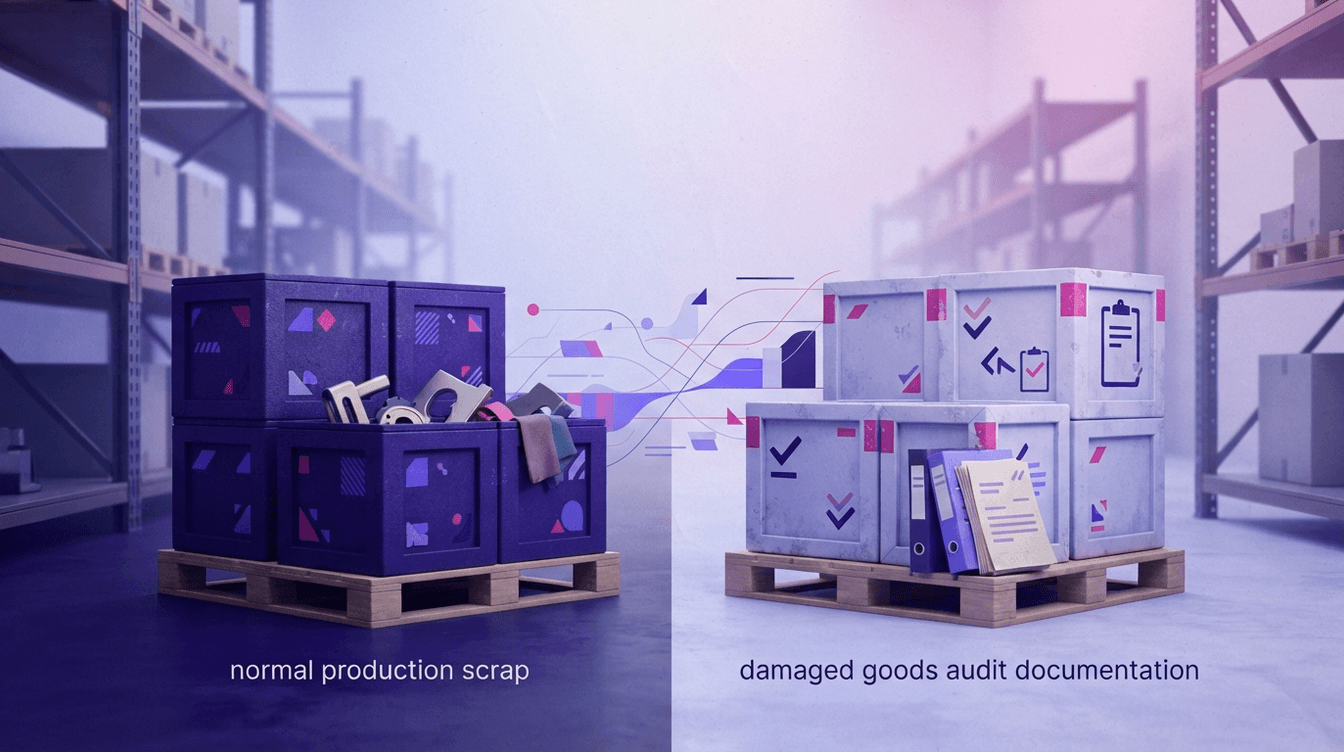
- Normal Waste: Inevitable reductions that occur within the framework of physical rules during the manufacturing process or due to the nature of the goods. For example, the evaporation of fuel, flour flying off as dust from sacks, or fabric cutting waste fall under this scope.
- Damaged Goods: Goods that are put out of action and completely lose their commercial value due to involuntary disasters such as fire, floods, earthquakes, or reasons like theft, spoilage, or expiration dates passing.
- Spoiled Inventory: Goods that have completed their shelf life, are in a condition unfit for consumption in terms of food safety, or have become technologically obsolete and unsellable. They are generally evaluated under damaged status.
- Appraisal Commission: The authorized administrative body for determining the cost value of damaged goods and conducting transactions according to tax laws.
Comparison and Process Table
Depending on the type of losses occurring in your inventories, the procedures you need to perform in your preliminary accounting and the obligations imposed on you by tax legislation vary. The table below is summarized to help you manage these processes quickly:
| Inventory Loss Type | VAT Deduction Cancellation | Deductibility as Expense | Documentation / Burden of Proof |
|---|---|---|---|
| Normal Waste | Not required (It is a cost element) | Directly written to cost / expense | Sectoral standards and technical reports |
| Damaged Goods (General) | Deductible VAT is calculated and cancelled | Non-Deductible Expenses (KKEG) | Appraisal Commission decision or police report |
| Depreciated Goods | Transaction is made over the fair market value | Provision is set aside (Subject to conditions) | Appraisal Commission or valuation report |
As seen in the table, stricter rules apply in the event of damage to goods. While normal waste is accepted as inherent to the business and does not require extra adjustment in terms of VAT, damaged goods carry the obligation to return the VAT that was not previously paid to the state or was deducted (declared as VAT to be added).
Step-by-Step Implementation: Tracking Order in Preliminary Accounting
The steps that preliminary accounting and official accounting departments must follow for spoiled, missing, or wasted goods detected as a result of inventory counts require a certain discipline. To manage the process correctly, you should follow these steps:
Step 1: Physical Identification and Count Report
When a shortage is detected as a result of regular counts in your warehouse, the situation must be recorded immediately with an "Inventory Count and Waste/Damage Report." The type, quantity, unit cost, and estimated cause of loss of the missing products must definitely be written in the report.
Step 2: Determination of Legal Status
Whether the loss suffered by the product remains within normal waste limits or constitutes damage is evaluated together with your financial advisor. If the quantity is appropriate to sectoral customs and at a reasonable rate, it is processed as normal waste.
Step 3: Official Documentation and Commission Process
If the goods are damaged (e.g., fire, flood, or large-scale spoilage), it may be necessary to obtain insurance reports, police reports, or an Appraisal Commission decision pursuant to the Tax Procedure Law. Especially for food and cosmetic products to be destroyed, it is mandatory to draw up a destruction report in the presence of local municipal or environmental units.
Step 4: Preliminary Accounting and VAT Adjustment Records
In the event of damage to goods, the VAT amount included in the purchase invoice of the goods and previously subjected to deduction is removed from deduction accounts by being added to the "VAT to be Added" line of the relevant period's VAT return. The cost value of the goods is debited to the Non-Deductible Expenses (KKEG) account.
Common Mistakes and Risks
Some common mistakes made by businesses during waste and damage recording in their preliminary accounting processes can lead to facing severe penalties in tax audits. To avoid these risks, you should pay attention to the following points:
- Directly Expensing Damaged Goods: Writing off the cost of spoiled or stolen goods in the warehouse directly to ordinary expense accounts (e.g., accounts 760 or 770) is the most common mistake. Such costs must be recorded as KKEG.
- Forgetting the VAT Adjustment: Failing to cancel the previously deducted VAT for damaged goods brings the risk of tax loss penalties before the GİB. Deductible VAT must definitely be adjusted in the return.
- Undocumented Destruction Processes: Tossing expired or spoiled products into the trash without reports and commissions can lead to these goods being treated as "secret sales" in tax audits. Every destruction must be documented.
- Using Excessive Waste Rates: Determining normal waste rates well above sectoral customs attracts the attention of tax offices and becomes a ground for audit.
Frequently Asked Questions
1. Should I make a VAT adjustment when throwing away expired food products?
Yes. Food products whose expiration date has passed and which have lost their commercial qualification are considered damaged goods. The VAT amount included in the purchase invoice of these goods and previously deducted must be cancelled by including it in the taxable base of calculated VAT in the VAT return of the period they are destroyed.
2. Is an Appraisal Commission decision mandatory for stolen goods?
In theft incidents, applications made to law enforcement authorities, police reports kept, and prosecutor's office investigation documents can often replace the Appraisal Commission decision. However, it is still beneficial to complete the documentation process completely under the guidance of your financial advisor.
3. Is it necessary to get permission from the tax office for normal waste?
Since normal waste occurs in accordance with the customs, technical conditions, and traditions of the relevant sector, special permission from the tax office is not required every time. However, it is essential not to exceed reasonable rates accepted in the sector.
4. How should spoiled inventory be written off in the preliminary accounting software?
You can ensure that your cost and inventory reports always remain up-to-date by writing off such inventories from the warehouse with special transaction types like "Waste Out" or "Damaged Goods Out" in your preliminary accounting software.
Summary and Next Steps
Waste and damage processes in inventory management are sensitive issues that directly affect the profitability and legal compliance of businesses. Correctly defining normal waste, and flawlessly completing the documentation and VAT adjustment procedures for damaged goods prevents potential tax penalties. To gain detailed information during the preparation phase, you can also review our preparing for the VAT return guide.
You can digitize your business immediately by opening a free account on Qolay.App to track your inventories instantly, easily report your warehouse waste, and manage your preliminary accounting processes flawlessly.
This article is for general informational purposes. Tax legislation, communiqué limits, and application details are updated periodically; consult your financial advisor and GİB announcements for your own business's situation.
Try it after reading
Start applying what you read with Qolay.App — for free.
Related articles
Other guides close to this topic.

Solutions That Bring Ease to Accounting
Don't Look for a Solution Before Finding Where You Lose Time
If accounting work takes time, you first need to figure out which step is stealing it. From receipt entry to reconciliation, we've listed the five most time-consuming steps and their corresponding solutions.
Common Mistakes in E-Commerce Accounting
Why is Profit Shrinking While Revenue is Growing?
When marketplace commissions, returns, shipping, and payment terms come together, records get confused quickly. We have written down the six most costly mistakes and how to prevent each one.

Inflation Accounting and SMEs
Is Paper Profit Real Profit?
Inflation adjustment converts the balance sheet into today's money. We explained what it is, who it covers, and what business owners need to change in their daily decisions.