

What is a Trial Balance? 7 Accounts Business Owners Must Check Monthly
A guide to reading a trial balance to protect your business's financial health. Learn how to check 7 critical accounts monthly.
On this page
What is a Trial Balance and Why is it Vital for Your Business?
As an SME, e-commerce seller, or freelancer operating in Turkey, you issue hundreds of invoices, process collections, and make payments to suppliers every month. At the end of the day, you must know where all these financial movements are going, whether your business is profitable or at a loss, how much you are owed by your customers, and how much you owe your suppliers. This is exactly where the concept of the "trial balance," the heart of pre-accounting, comes into play. Most business owners ignore this complex table of numbers provided by their financial advisors or only remember it during the year-end tax return period. However, the trial balance is an instant X-ray of your business; if not reviewed regularly, it becomes impossible to notice hidden cash leaks, inventory losses, or incorrect invoicing.
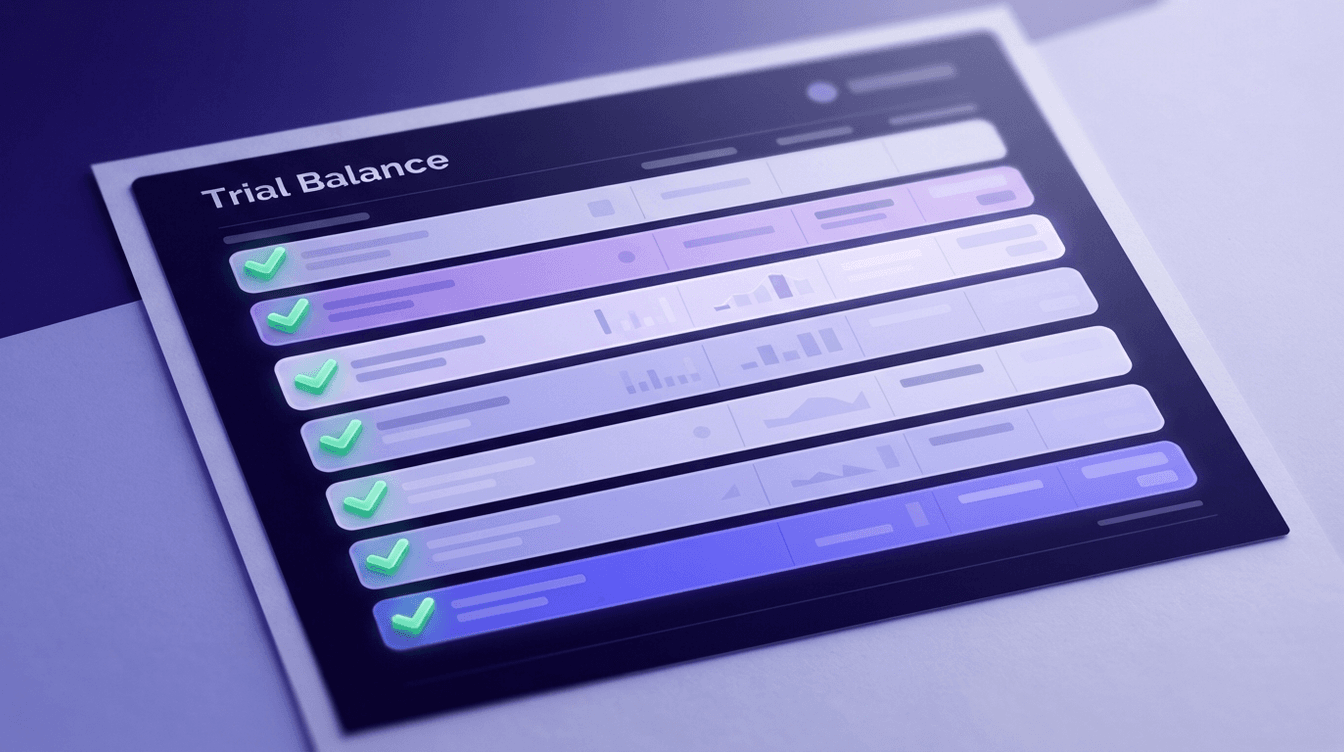
So, what is a trial balance? In its simplest definition, a trial balance is a control statement that lists the debit and credit totals of the accounts in the general ledger, either with or without balances. It is a general summary of your business as of a specific date. Developing the habit of reading a monthly trial balance not only increases your financial literacy but also serves as your greatest shield during potential tax audits and cash flow crises. When you move your pre-accounting processes to a digital environment by incorporating the principles of the practical guide to bank and cash management, performing a trial balance check will transform from a manual chore into a strategic routine taking only a few minutes.
In this comprehensive guide, we will detail the 7 critical accounts you must check without exception every month to protect your business's financial health, common errors in these accounts, and methods for quick reconciliation. With the practical steps you will find in the rest of this article, you will completely change your dialogue with your financial advisor and be able to manage the Digital Collaboration with Financial Advisor: Transitioning from Paper Folders to Cloud Collaboration process flawlessly.
Basic Framework: Types of Trial Balances and Logic of Reading
To fully grasp the concept of a trial balance, one must first know its types and the accounting logic behind it. Trial balances prepared within the framework of the Uniform Chart of Accounts (TDHP) are basically divided into two: Monthly (Temporary) Trial Balance and Final Trial Balance. While monthly trial balances show the movements and cumulative totals for that month at the end of each month throughout the year, the final trial balance is the report prepared before year-end closing entries, providing a perfect summary of the entire period. As a business owner, what you should focus on is the "monthly trial balance" report that you will request from your pre-accounting software or financial advisor in the first week of each month.
A trial balance structure usually contains the following columns: Account Code, Account Name, Debit Total, Credit Total, Debit Balance, and Credit Balance. According to the fundamental rule of accounting, the total debit amount must always equal the total credit amount. If the totals of these two main columns do not match, it means there is a mathematical or logical error in your records. The key points business owners should pay attention to when reading a trial balance are:
- Accuracy of Account Balances: An asset account (such as cash or bank) should never have a credit balance (negative balance). If it does, it means there is an unrecorded transaction or a missing document.
- Periodicity Principle: It should be checked whether the income and expenses for the relevant month are collected in the correct accounts.
- Cumulative Tracking: Trends in turnover, cost, and expense increases should be monitored by comparing them with previous months.
- Reconciliation: It should be verified whether the figures appearing in the trial balance match real life, as in the answer to the question how to track current accounts.
7 Critical Accounts to Track Monthly and Comparison Table
Regardless of the size of your business, there are 7 main account groups you need to focus on to avoid getting lost among the hundreds of accounts on the trial balance. These accounts directly reflect your business's cash flow, commercial relationships, and tax obligations. In the table below, we have summarized the codes, meanings, and monthly control criteria for these 7 critical accounts:
| Account Code | Account Name | What Does It Represent? | Monthly Control Criterion |
|---|---|---|---|
| 100 | Cash Account | Physical cash available in the business. | Must match physical count, never show a negative balance, and not be inflated. |
| 102 | Bank Accounts | Total assets in company bank accounts. | Must match bank statements exactly. |
| 120 | Receivables (Current) | Receivables waiting to be collected from customers. | Overdue receivables should be filtered, and doubtful receivables should be separated. |
| 153 | Commercial Goods | Cost value of stocks held for sale. | Must be compatible with warehouse count and e-commerce inventory. |
| 191 / 391 | Deductible and Calculated VAT | VAT movements in purchases and sales. | Must match perfectly with the VAT return accrual. |
| 320 | Payables (Current) | Commercial debts to suppliers. | Reconciliation should be made with supplier statements. |
| 600 | Domestic Sales | Net sales of goods and services realized in the relevant month. | Must be compatible with the totals of issued e-invoices/e-archives. |
Each account in this table is a reflection of your business's commercial dynamics. For example, for e-commerce sellers, a mismatch between the 600 Domestic Sales account and marketplace settlement reports is the first sign that commission and shipping deductions are being accounted for incorrectly. Similarly, the difference between 191 Deductible VAT and 391 Calculated VAT directly determines your deferred VAT or VAT to be paid for that month.
Step-by-Step Implementation: Monthly Trial Balance Reconciliation Process in Pre-Accounting
Instead of leaving the trial balance to your financial advisor and sitting back, you should establish your own internal audit mechanism between the 5th and 10th of each month. This process will maximize the financial discipline of your business. The trial balance reconciliation guide you can apply step-by-step is as follows:
- Step 1: Get the Report. Request the trial balance for the previous month from your pre-accounting software or financial advisor.
- Step 2: Check Cash and Banks. Confirm whether the amount in the 100 Cash account is the same as the physical money actually in your safe. Compare the 102 Bank account with your internet banking balance.
- Step 3: Review Customer and Supplier Balances. Compare the totals of the 120 Receivables and 320 Payables accounts with the reconciliation balances of your main customers and suppliers. Note any doubtful balances that have not seen movement for a long time.
- Step 4: Perform VAT Reconciliation. By taking the difference between the 191 and 391 accounts, check if it matches the VAT amount to be paid or deferred in the return to be submitted to GİB.
- Step 5: Sales and Cost Compatibility. Ensure that the 600 Domestic Sales account is consistent with the total of the e-invoices you issued that month, excluding VAT.
Example Scenario: XYZ Limited Company has made a total of 500,000 TL (excluding VAT) in sales throughout the month via e-commerce. However, the business owner, who examined the trial balance, noticed the situation immediately when they saw 420,000 TL in the 600 Domestic Sales account. Upon investigation, it was understood that marketplace commissions were processed by netting them out rather than on the gross amount, which is why sales appeared incomplete. Thanks to the quick reconciliation, this error was corrected before the month closed, preventing a major penal situation and incorrect blind account reporting during the temporary tax period.
Common Errors and Risks for Your Business
Some typical errors made in trial balance reading and control processes damage the financial structure of businesses and create legal risks. Being aware of these errors and taking proactive measures is essential for your financial security. Here are the 4 most common errors and their solutions:
- Inflation of the 100 Cash Account: Keeping money in the cash account for years that is not actually there (receivables from partners or inflated cash balances) leads to very serious tax penalties and criticisms of disguised profit distribution during GİB audits. Solution: Keep the cash balance close to zero monthly and manage it realistically.
- Failure to Track Current Accounts: The ambiguity of who is a debtor and who is a creditor in the 120 and 320 accounts paves the way for failure to collect and bankruptcy risk. Solution: Get regular aging reports.
- Confusing Temporary Trial Balance with Final Trial Balance: Assuming that some periodic transitions in monthly temporary trial balances are the final state leads to wrong decisions regarding profit distribution or partner current accounts. Solution: Evaluate reports in a periodic context.
- Incorrect Reflection of Stock Costs: The fact that the 153 Commercial Goods account does not match the actual inventory causes you to pay excess tax or make incomplete declarations by showing costs incorrectly, and also causes your profitability to be calculated incorrectly. Solution: Perform periodic physical counts.
Frequently Asked Questions
Is it necessary to know accounting to examine the trial balance?
You do not need to know advanced accounting techniques. Knowing what the basic account codes (100 cash, 120 receivables, 320 payables, etc.) mean and checking the logical consistency of the numbers is more than enough for a business owner.
Why does the 100 Cash account give a negative balance and how is it corrected?
If the cash account gives a negative balance, an expense or payment made from the cash register has been recorded in the accounting, but the cash inflow (collection or capital addition record) to that register has been forgotten. You should consult your financial advisor and have the missing collection documents entered into the system to correct it.
Does monthly trial balance control protect against tax audits?
Although it does not directly prevent a tax audit, it prevents potential tax penalties and tax base differences by ensuring that obvious inconsistencies on the trial balance (such as huge cash balances or incompatible VAT amounts) are detected and corrected in advance.
How often should I request the trial balance from my financial advisor?
The ideal is to request the temporary trial balance for the previous month in the first week of each month. This way, you both perform a check before the VAT return and keep track of your business's performance fresh.
Do Not Let Go of Financial Control
To grow your business, secure your cash flow, and avoid tax surprises, you must be in control of your pre-accounting data. The habit of reading a trial balance saves you from intuitive decisions and moves you to a management approach based entirely on data. By opening a free account on Qolay.App, you can easily manage all these financial processes, your invoices, collections, and current accounts from a single screen, and achieve perfect digital harmony with your financial advisor.
This article is for general information purposes. Tax legislation, notification limits, and application details are updated periodically; consult your financial advisor and GİB announcements for the status of your own business.
Try it after reading
Start applying what you read with Qolay.App — for free.
Related articles
Other guides close to this topic.

What is Pre-Accounting? Why Is It Crucial for Your Business?
The Cornerstone of Financial Control
If you don't know what's left in the cash register at the end of the month, the problem isn't in sales, it's in record-keeping. We explain what pre-accounting is, how it differs from general accounting, and how to set it up in practice for a small business.
Order, Commission, and Invoice Reconciliation for N11 and Pazarama Sellers
Coupon Discounts, Cancellations, and Period-End Entitlement Controls
A order, commission, and entitlement reconciliation guide for SMEs selling on N11 and Pazarama. Examining coupons and invoicing.

What is DBS (Direct Debiting System)? Advantages for Buyers and Sellers
Bank-Guaranteed Collection Mechanism in Dealership and Wholesale Sales
What is DBS, which solves the collection problem—the biggest risk in trade? Its advantages for buyers and sellers, how it works, and preliminary accounting tips are in this guide.