

Meat, Sauce Grammage, and Packaging Cost in Burger Shops and Fast Food Businesses
Track patty grammage, homemade sauce semi-products, packaging boxes, and grill waste in a single workflow for burger and fast food businesses with Qolay.App.
On this page
Three Invisible Factors That Determine Profit in a Burger Kitchen
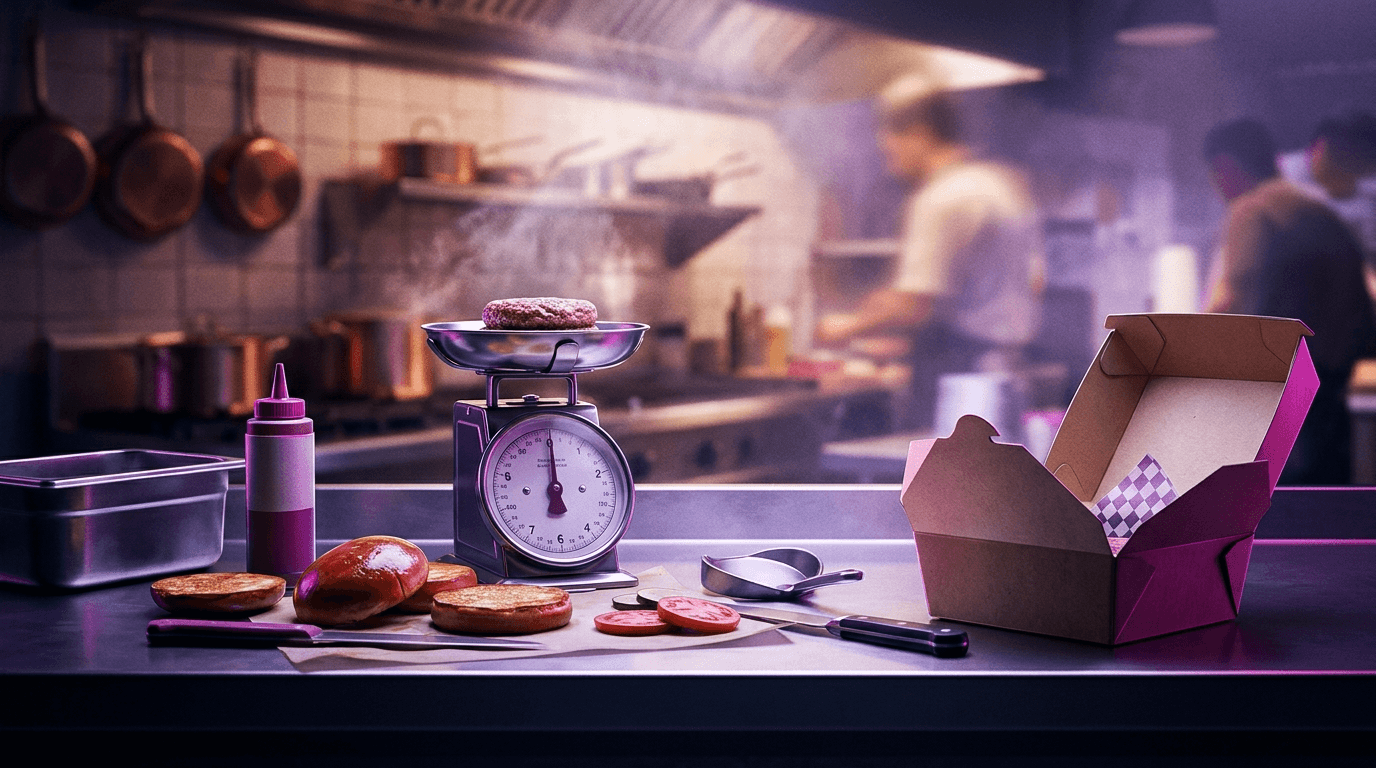
A burger restaurant or fast-food spot races against the clock during peak hours. Every smash burger that goes out to a customer contains a beef patty, brioche bun, cheddar cheese, and a signature house sauce; for takeout orders, greaseproof paper, a cardboard burger box, and a carry bag are added to the mix. The problem is that many business owners focus solely on the price per kilo of ground beef while leaving out the extra sauce squirted onto portions, the patty burned on the grill, or the takeaway box whose unit price increases every month.
Another dimension to this is the prep kitchen. You prepare your special burger sauce or seasoned meat mix in bulk ahead of time and send it to the service line. Without costing these intermediate products (semi-finished goods) accurately and establishing grammage discipline per portion, it is impossible to figure out whether discount campaigns on online food delivery platforms are leaving you with a profit or a loss.
Why Simple Recipes and Production Entries Instead of Heavy ERP and MRP?
Heavy ERP or MRP systems developed for large restaurant chains are overly complex for a burger joint or cloud kitchen with 1–3 branches. Setting up separate workflows and complex planning tables for each station tires out the kitchen staff. What small and medium-sized food and beverage businesses need is a fast and straightforward pre-accounting production structure integrated with purchase invoices.
Qolay.App is a pre-accounting platform. In the Production Management module, Web and iOS/Android mobile screens operate with the exact same simple structure. You create a single recipe for each product. If you use semi-finished sauces or patty mixes, you produce and stock the semi-finished good before waiting for automatic sub-production; then, at the end of the day or service, you enter the number of successful burgers produced and the resulting grill waste with a single record on the Production Entries screen.
Realistic Scenario: The Cost of 100 Takeout Classic Smash Burgers
Let's assume a production entry is made for 100 Takeout Classic Smash Burgers at the end of the day. First, the Special Burger Sauce (kg) semi-finished good was produced in the kitchen and entered into stock at a cost of 200 TL per kilo. Next, the recipe consumption, additional costs, and grill waste for 100 burgers are brought together in the table below:
| Cost Item (For 100 Units) | Record Type | Quantity / Calculation | Amount (TL) |
|---|---|---|---|
| Beef Patty Mix | Component | 100 × 0.15 kg = 15.00 kg × 440 TL | 6,600.00 TL |
| Brioche Burger Bun | Component | 100 × 1 unit = 100 units × 14 TL | 1,400.00 TL |
| Cheddar Cheese | Component | 100 × 0.03 kg = 3.00 kg × 400 TL | 1,200.00 TL |
| Special Burger Sauce (Semi-Finished) | Component | 100 × 0.04 kg = 4.00 kg × 200 TL | 800.00 TL |
| Raw Material Total | Subtotal | 6,600 + 1,400 + 1,200 + 800 | 10,000.00 TL |
| Grill Energy & Exhaust Hood Share | Additional Cost (Service–Percentage) | Raw material only (10,000 TL) × 10% | 1,000.00 TL |
| Kitchen Prep Fixed Labor | Additional Cost (Service–Amount) | Daily fixed (multiplication disabled) | 500.00 TL |
| Box + Greaseproof Paper + Carry Bag | Additional Cost (Stock) | 100 units × 12 TL (multiplication enabled) | 1,200.00 TL |
| Burned Grill Patty (Waste 1) | Enter Waste | 0.50 kg × 440 TL (does not apply to 10% base) | 220.00 TL |
| Slices / Melted Cheese Loss (Waste 2) | Enter Waste | 0.20 kg × 400 TL (does not apply to 10% base) | 80.00 TL |
| Total Production Cost | Grand Total | 10,000 + 300 + (1,000 + 500 + 1,200) | 13,000.00 TL |
| Unit Burger Cost | 100 Good Units | 13,000.00 ÷ 100 | 130.00 TL / unit |
Although the raw meat cost of a burger appears to be 66 TL, when you add the bun, cheese, semi-finished sauce, grill energy, labor, box-bag, and a total of 300 TL in waste, the actual unit cost reaches 130.00 TL. Joining a food delivery platform campaign without knowing this figure puts profitability at risk.
Step-by-Step Kitchen Setup with Qolay.App
- 1. Create the Semi-Finished Sauce Recipe (Production → Recipes): Save the Special Burger Sauce recipe consisting of mayonnaise, mustard, pickle juice, and spices on a 1 kg basis. When the sauce batch is ready, make a production entry for it first to update the stock.
- 2. Define the Burger Recipe: Add meat, bun, cheddar, and the semi-finished sauce to 1 unit of the Classic Smash Burger recipe. In the Additional Costs tab, enter rows for 10% grill energy, fixed daily labor, and packaging box (Stock type).
- 3. End-of-Day Production and Waste Entry (Production → Production Entries): Record the 100 good burgers sold/prepared during the day or at closing in a single form. Add patties and cheese lost due to burning or dropping separately via the Enter Waste window.
- 4. Manage Dine-In vs. Takeout Differences: If burger boxes are not used for dine-in service, you can remove the box from the additional cost row in that production record or create a separate product card for takeout/dine-in; custom adjustments to production do not break the master recipe.
- 5. Monitor Consumption and Margin (Production → Reports): View weekly meat and sauce consumption with the Raw Material Consumption report; check whether your menu prices are sufficient using the "Show margin" toggle in the Recipe Cost report.
5 Common Cost Mistakes in Fast Food and Burger Joints
- Squirting Sauce by Eye: If the sauce specified as 40 grams (0.04 kg) in the recipe is squirted as 70 grams in practice, the discrepancy between the Raw Material Consumption report and the physical count immediately exposes sauce waste.
- Leaving the Packaging Set (Box, Wet Wipe, Napkin) Out of Costs: In locations where the takeout ratio exceeds 60%, packaging sets are the fastest-growing expense; they must be deducted from stock using a stock-type additional cost.
- Failing to Measure Cooking and Burning Waste for Meat: Not tracking the difference between raw and cooked weights and the patties burned and thrown into the trash using Enter Waste creates continuous deficits in meat inventory.
- Entering Uninvoiced Butcher or Greengrocer Purchases Late into the System: When production is made without entering invoices, inventory drops into negative and costs may appear as zero; you must process invoices on the same day to ensure the nighttime FIFO engine calculates accurately.
- Mixing Food Platform Commissions into the Recipe Margin: Recipe cost is the kitchen exit cost; when setting your menu price, do not forget to add the platform commission rate on top of this 130 TL base.
Frequently Asked Questions
Will I be prevented from entering burger production if sauce stock runs out?
No. When stock is insufficient, the system gives a warning but does not block the production record. Negative stock is corrected once you enter the production entry for the semi-finished sauce or the purchase invoice for the missing raw material.
Do I need to update all burger recipes one by one when the kilogram price of meat increases on the butcher's invoice?
No. When you process the purchase invoice into the system, the recipe cost is automatically updated based on FIFO and the latest purchase sequence; the nighttime FIFO engine also finalizes past productions from the new layers.
Can the head chef enter production and waste from their phone?
Yes. Qolay.App offers the exact same 3 production screens on web and iOS/Android mobile apps. An authorized standard kitchen supervisor can enter production and waste from their phone in a few taps at the end of the day.
Protect Your Menu Profitability with Grammage and Box Control
The way to increase the net amount remaining in the cash register at the end of the month in burger and fast-food businesses is to regularly monitor every patty grammage, homemade sauce, and takeout box. For details, you can review the Qolay.App Production Management page; and check out our articles on Yemeksepeti, Getir, and Trendyol Food Accounting and Restaurant and Cafe Pre-Accounting Cost Control for online platform deductions. The Production Management module is offered as a separate add-on through Qolay Market and comes with an open trial period. Take control of your kitchen costs right now by opening a free account on Qolay.App.
This article is for general informational purposes. Consult your financial advisor for food sector VAT rates, document layout, and cost accounting practices.
Try it after reading
Start applying what you read with Qolay.App — for free.
Related articles
Other guides close to this topic.
Cooking Shrinkage and True Portion Profitability Calculation for Döner and Kebab Shops
Simple Control from Raw Meat Grams to Cooked Portion Cost
Learn how to calculate cooking and trimming shrinkage of raw meat, marinade expenses, lavash-box consumption, and true portion profitability in döner and kebab shops.
What is a Trial Balance? 7 Accounts Business Owners Must Check Monthly
Quick Reconciliation for 100 Cash, 120 Receivables, 320 Payables, and VAT Accounts
A guide to reading a trial balance to protect your business's financial health. Learn how to check 7 critical accounts monthly.