

Cooking Shrinkage and True Portion Profitability Calculation for Döner and Kebab Shops
Learn how to calculate cooking and trimming shrinkage of raw meat, marinade expenses, lavash-box consumption, and true portion profitability in döner and kebab shops.
On this page
You Put on 50 Kilos of Meat, But How Many Portions Came Off the Grill?
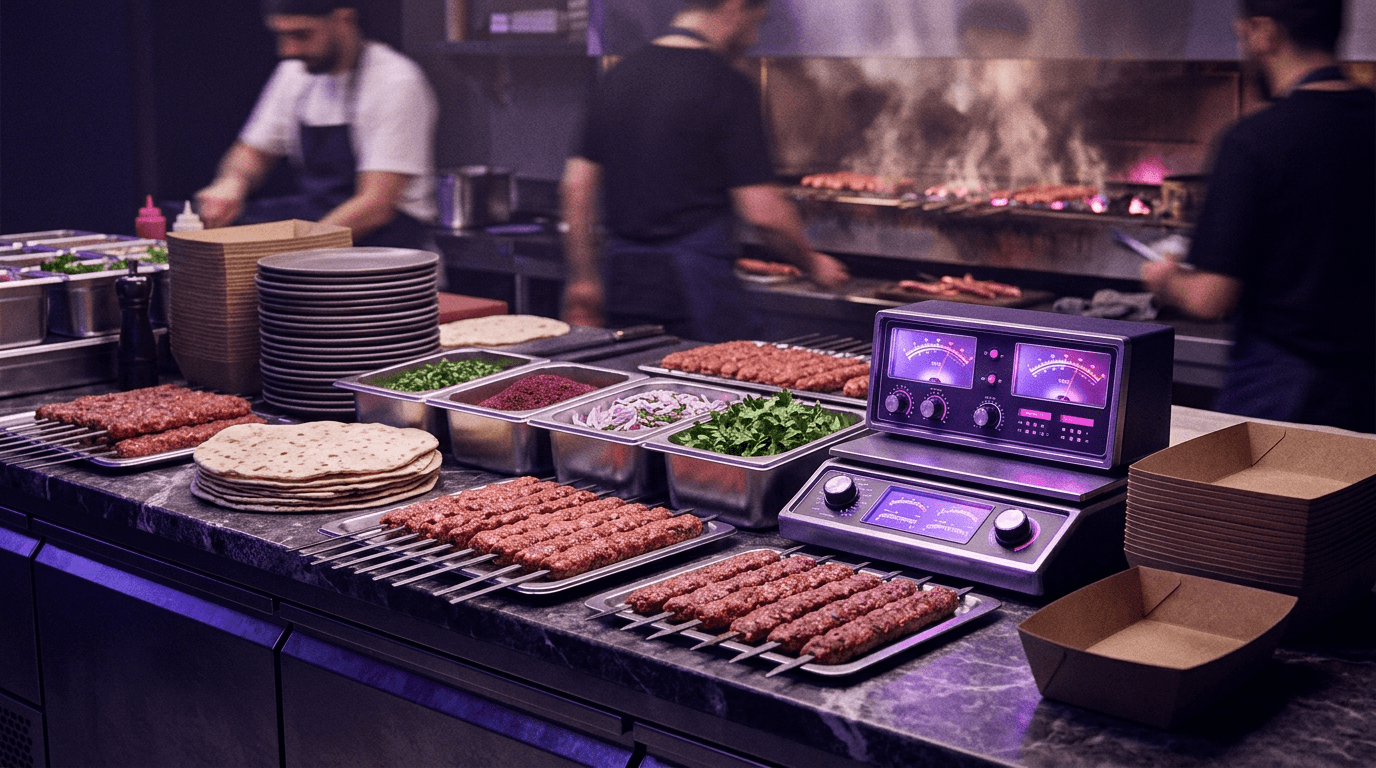
For döner shops, kebab houses, and grill restaurants, the beating heart of profitability lies in meat waste and shrinkage rates. When 40 kilograms of raw meat bought from a butcher or processing facility is marinated and put on the skewer, you certainly won't sell 40 kilograms of cooked meat when the counter closes at night. Water lost during cooking, rendered fat, trimming waste left by the master chefs, and end-of-day drying shrinkage account for a significant portion of the total weight.
Many restaurant owners simply divide the price per kilo of raw meat by the portion weight when setting their menu prices—thinking, for example, "Meat is 520 TL per kilo, so a 100-gram portion is 52 TL." However, when you factor in cooking shrinkage, tail fat, marinade, stove gas, flatbread (lavaş), and takeout boxes, the actual cost per portion is nearly double that amount.
Why Simple Recipes Instead of Complex ERP for Restaurant Kitchens?
Heavy ERP and MRP software designed for large chain restaurant groups offers central kitchen shift schedules, multi-warehouse delivery routes, and complex work order flows. For a döner or kebab shop with a single branch or just a few locations, these structures simply don't fit the kitchen's pace. What the operator actually needs is: price updates when a meat purchase invoice arrives, recording the portions produced at the end of the day in a single form, and tracking the actual waste generated on the skewer separately.
Qolay.App is a pre-accounting platform; its Production Management module operates with the exact same simple screens on both the web panel and the iOS/Android mobile apps. You enter the amount of meat put on the skewer in the morning and the number of solid portions produced during the day in a single form, while processing the cooking/drying waste—which varies depending on the fat content of the meat that day—in a separate Enter Waste window.
Sample Cost Table: 250 Portions of Cooked Döner Output
Let's assume 250 portions of Döner Wrap / Takeout (with 100g of cooked meat) are prepared during the day. The recipe includes 0.14 kg of beef flank/entre-côte (including the cooking allowance), 0.02 kg of lamb tail fat, and 0.02 kg of marinade per portion. The 3.50 kg of beef lost to excess melted fat, trimming, and end-of-day drying shrinkage has been processed through the Enter Waste window. Flatbread, thermal wrap paper, and leak-proof takeout boxes have been deducted as Stock-type additional costs.
| Item Type | Material / Expense | Quantity (250 Portions) | Unit Price | Total Amount |
|---|---|---|---|---|
| Raw Material | Beef Flank and Entre-côte (0.14 kg/portion) | 35.00 kg | 520.00 TL | 18,200.00 TL |
| Raw Material | Lamb Tail Fat (0.02 kg/portion) | 5.00 kg | 320.00 TL | 1,600.00 TL |
| Raw Material | Yogurt, Onion & Spice Marinade (0.02 kg/portion) | 5.00 kg | 90.00 TL | 450.00 TL |
| Subtotal | Total Raw Materials | - | - | 20,250.00 TL |
| Enter Waste | Skewer Trimming & End-of-Day Drying Shrinkage | 3.50 kg (Beef) | 520.00 TL | 1,820.00 TL |
| Service–Percentage | Skewering, Cutting, and Grill Gas Allowance (8%) | 20,250.00 TL × 8% | - | 1,620.00 TL |
| Service–Amount | Grill Cleaning and Prep (fixed amount) | 1 batch | 500.00 TL | 500.00 TL |
| Stock Extra Cost | Flatbread + Wrap Paper + Takeout Box | 250 pcs (multiplied) | 14.00 TL | 3,500.00 TL |
| Total | 250 Portions of Meat Döner | Unit: 110.76 TL/portion | - | 27,690.00 TL |
In the table, the 8% Service–Percentage allowance is calculated solely over the raw material total of 20,250.00 TL, coming to 1,620.00 TL; the 1,820.00 TL skewer waste and 3,500.00 TL flatbread-packaging stock are not included in the percentage base. When all items are added up, 27,690.00 TL ÷ 250 portions = an actual portion cost of 110.76 TL. This is your true base cost before even adding online food platform commissions.
Step-by-Step Cost Control in the Kitchen with Qolay.App
- 1. Create the Recipe (Production → Recipes): Open a single recipe for each main menu item, such as döner, Adana kebab, or İskender. Define meat and fat in kg, and flatbread and packaging containers as Stock extra costs (units).
- 2. Enter End-of-Day Production and Meat Waste (Production → Production Entries): At evening cash register closing, enter the number of portions sold. Process any meat left over or dried out on the skewer via the Enter Waste window. Even if the meat invoice arrives late, the system won't block production; once the invoice is entered, the nighttime FIFO engine finalizes the cost.
- 3. Semi-Finished Marinated Meat When Needed: If you first prepare "Marinated Skewer Meat" and let it rest for a few days, record the semi-finished production first since there's no automatic sub-production; then consume this semi-finished item during daily portion outputs.
- 4. Open the Margin Report on Meat Price Hikes (Production → Reports): When the butcher's invoice comes in with a price increase, instantly see which portion's profitability has dropped using the Recipe Cost ("Show margin") report; compare which master chef or meat supplier is generating higher waste using the Waste Report.
5 Common Cost Mistakes in Döner and Kebab Shops
- Calculating Raw Weight Like Cooked Weight: 100g of cooked döner requires 135–150g of raw meat depending on the meat quality; if cooking loss is forgotten, meat stock runs out by the middle of the month.
- Not Recording Dried Meat Left on the Skewer at Day's End as Waste: If meat that doesn't carry over to the next day or gets thrown out isn't deducted via Enter Waste, profitability will look artificially high.
- Not Counting Flatbread, Pickles, Roasted Peppers, and Takeout Boxes in the Cost: Especially in online food orders, foil, boxes, wet wipes, and cutlery sets add an extra load of 12–20 TL per portion.
- Waiting Months to Update Menu Prices When Butcher Purchase Prices Change: Failing to check the Recipe Cost report weekly during rapid spikes in meat prices eats away at your profit.
- Not Calculating Food Platform Commissions on Gross Prices: "Buy 1, get 1 free" or coupon campaigns launched without knowing the exact portion cost translate directly to losses.
Frequently Asked Questions
The water and fat loss of meat changes every day, can I put a fixed waste rate in the recipe?
There is no waste rate field on the Qolay.App recipe screen. You process the actual daily cooking and trimming waste through the Enter Waste window during production entry, allowing you to accurately measure the real waste that varies depending on the type of meat.
If I serve both a 100g wrap and a 150g İskender from the same meat, how should I define it?
You need to define a separate finished product card for each menu item and individual recipes based on the meat/flatbread/pide quantities for that specific portion.
Can production and waste entries be made from mobile during the day before the register closes?
Yes. The iOS/Android mobile app is identical to the web screens; the branch manager can complete entries in a few seconds from a mobile device during evening closing.
True Profitability from the Grill to the Cash Register
The way to know your actual earnings per portion in döner and kebab shops is to regularly record raw meat consumption, skewer waste, and packaging supplies. You can activate the Production Management add-on module while the trial period is open via Qolay Market and test your kitchen recipes. For details, you can visit the Qolay.App Production Management page, and also check out our articles on Restaurant and Cafe Pre-Accounting Cost Control and Yemeksepeti, Getir, and Trendyol Yemek Accounting.
Open a free account on Qolay.App to immediately start tracking your portion costs and meat waste.
This article is for general informational purposes. VAT rates, receipt/document order, and cost records for food businesses may vary according to regulations; consult your financial advisor.
Try it after reading
Start applying what you read with Qolay.App — for free.
Related articles
Other guides close to this topic.
Formula, Jerrycan, and Label Costs in Small-Scale Cleaning and Detergent Manufacturing
Net Unit Cost with Active Ingredients, Fragrance, Packaging Stock, and Filling Waste
Manage chemical formula components, tank-bottom waste, 5-liter jerrycan-cap-label stock, and labor costs in small cleaning and detergent filling businesses with Qolay.App.
Meat, Sauce Grammage, and Packaging Cost in Burger Shops and Fast Food Businesses
Net Margin Control through Semi-Finished Burger Sauce First, Then Menu Production
Track patty grammage, homemade sauce semi-products, packaging boxes, and grill waste in a single workflow for burger and fast food businesses with Qolay.App.
How to Calculate Product Cost?
Purchase Price Is Not Cost
Thinking that the cost is just the purchase price is one of the most expensive mistakes. We explained how to allocate shipping, waste, and overhead costs.