

Daily Menu Cost and Waste Control in Catering and Table d'Hôte Food Companies
Learn how to manage daily portion recipes, meat and vegetable trimming waste, disposable container packaging, and delivery costs in catering and table d'hôte food companies with Qolay.App.
On this page
Why Do Daily Costs Come as a Surprise in Catering and Set-Menu Kitchens?
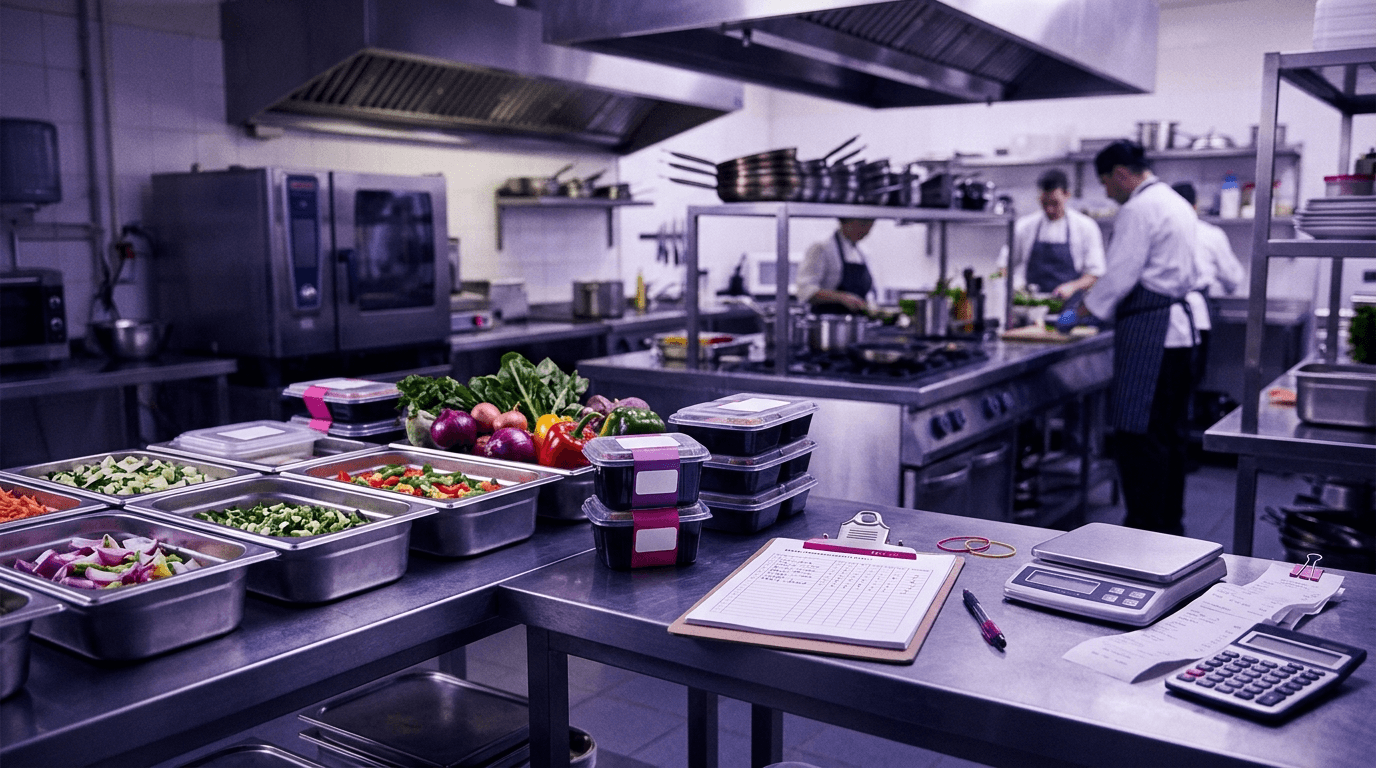
Catering and set-menu production companies deliver hundreds or even thousands of portions every day at a fixed contract price. With fixed monthly set-menu agreements, profit margins are already very thin; even a variance of 3–5 TL per portion can wipe out the entire profit by the end of the month. Especially trimming meat sinew and fat, or peeling and sorting out spoiled potatoes and carrots, constantly challenges the on-paper recipe every day.
In addition, three-compartment leak-proof microwave containers, lids, cutlery sets, and hot delivery expenses directly add to each portion. Most set-menu companies try to figure out whether they are making a profit by simply looking at end-of-month cash registers and supplier invoices; however, when the daily portion cost is unknown, it can take days to notice which menu caused a loss.
Simple Tracking Suited to Kitchen Tempo Instead of Heavy Systems
It is unrealistic to expect a head chef or kitchen manager who arrives at the pots at 05:00 in the morning to fill out shift schedules, machine station approvals, or long forms in complex enterprise resource planning software. What the business needs is to enter how many portions were produced and how much waste was generated that day from a single screen once the meals are portioned and sent out for delivery.
Qolay.App is a pre-accounting platform that makes the kitchen team's job easier with its Production Management module. A single recipe is created for each main dish or menu item; when daily production is completed, the solid portions produced are entered through a single form. Records can be kept from a web browser or using the same screen on an iOS/Android tablet or phone in the kitchen; as meat and vegetable invoices are entered, the current FIFO cost is automatically calculated.
Numerical Example: Daily Production Cost of 250 Portions of Beef Forest Kebab
Let's examine the example of 250 portions of Beef Forest Kebab (product unit: Portion) produced for lunch service in a set-menu kitchen. Diced beef, vegetables, oil, and tomato paste are recorded as components; meat trimming and potato peeling loss are recorded via the separate Enter Waste window; and the leak-proof container set, kitchen energy rate, and delivery cost are recorded with three additional cost types:
| Cost Item | Item Type | Quantity × Unit Price | Total (TL) |
|---|---|---|---|
| Diced Beef | Component (0.14 kg/portion) | 35 kg × 520.00 TL | 18,200.00 TL |
| Potatoes | Component (0.10 kg/portion) | 25 kg × 28.00 TL | 700.00 TL |
| Carrots & Peas | Component (0.08 kg/portion) | 20 kg × 55.00 TL | 1,100.00 TL |
| Sunflower Oil | Component (0.02 lt/portion) | 5 lt × 140.00 TL | 700.00 TL |
| Tomato Paste | Component (0.02 kg/portion) | 5 kg × 160.00 TL | 800.00 TL |
| Component Subtotal | Food Raw Materials | 250 portions consumption | 21,500.00 TL |
| Meat Sinew & Potato Peeling Waste | Enter Waste Window | 1.50 kg Meat (780 TL) + 3 kg Potatoes (84 TL) | 864.00 TL |
| Leak-proof Container + Lid + Cutlery Set | Additional Cost: Inventory (× Quantity open) | 250 pcs × 9.00 TL | 2,250.00 TL |
| Kitchen Natural Gas, Water & Electricity (8%) | Additional Cost: Service–Rate (8%) | 21,500.00 TL × 8% (component base only) | 1,720.00 TL |
| Hot Delivery Fuel & Distribution Share | Additional Cost: Service–Amount (× Quantity closed) | Daily route delivery share | 1,166.00 TL |
| Grand Total & Portion Cost | 250 Solid Portions | 27,500.00 TL ÷ 250 portions | 110.00 TL/portion |
As can be seen, the 8% kitchen energy and natural gas rate is applied only to the 21,500.00 TL food component total; the 864.00 TL trimming waste and 2,250.00 TL packaging container cost are not included in the rate base, directly increasing the total cost. Thus, the true cost of a single portion, including packaging and delivery, becomes clear as 110.00 TL.
Daily Catering and Set-Menu Workflow with Qolay.App
- 1. Defining Menu Recipes (Production → Recipes): Open a single recipe for each dish. Enter meat, vegetables, oil, and tomato paste with their units on the product card (
kg,lt). Save tiffin carriers or disposable containers under theInventorytype ("Multiply with production quantity" open), the energy rate asService–Rate (%), and the delivery/chef share asService–Amount (TL). - 2. Daily Production and Trimming Waste (Production → Production Entries): Once portioning is complete, select the date, dish, number of solid portions produced (250), and default company warehouse, then approve the record. Enter the actual waste generated from vegetable peeling or meat trimming with a description via the Enter Waste window. If you receive the fresh vegetable invoice in the evening, the system will show an insufficient stock warning but will not block the entry; the balance corrects itself when the purchase invoice is processed.
- 3. Receipt PDF and Menu Profit Margin Analysis (Production → Reports): Following the instant cost, the FIFO engine finalizes the cost at night. You can get a customizable Production Receipt PDF to be kept in the delivery file for corporate clients. You can export up to 366 days of Production Summary, Raw Material Consumption, Waste Report (up to 5,000 rows), and Recipe Cost reports showing your profit margin according to the contract price with the "Show margin" option to Excel. Managers/Standard users write; Accountant or Read-Only roles review and print the reports.
4 Common Cost Mistakes in Catering Kitchens
- Ignoring Waste Loss on Carcass or Fatty Meat: If 36.5 kg of meat was cut for 35 kg of net meat, the meat cost will not be accurate without entering the 1.5 kg waste in between.
- Treating Disposable Containers and Packaging as Non-Menu Items: Lids, microwave containers, and cutlery sets go to the customer with every portion and must be deducted from inventory.
- Leaving Pot Bottoms and Returned Portions Unrecorded: Failing to track the raw materials of leftover or discarded meals at the end of the day inflates kitchen stock on paper.
- Delaying Reflecting Weekly Vegetable and Meat Price Hikes in Contracts: If "Show margin" is not checked in the Recipe Cost report, some dishes will be served at a loss during days with price increases.
Frequently Asked Questions
Should I enter the kilo of meat in kg instead of grams?
Yes, since there is no automatic unit conversion in the current version, if meat is defined as kg on the product card, you write 0.14 kg instead of 140 grams in the recipe.
How do I track if there are prep products like sauces or broth?
First, you produce the prep sauce with a semi-finished product recipe and take it into stock; then you select that sauce as a component in main dish recipes.
Can I change the packaging deduction if meals go out in our own termoboxes instead of subcontracted containers one day?
Yes. You can delete or edit the disposable container row within that day's Production Entry; your main recipe will not be disrupted.
Protect Your Profit in Your Set-Menu Contracts
Sustainable profitability in catering and set-menu food companies relies on knowing the true cost and trimming waste of every portion produced each day. For more comprehensive information on food and beverage accounting, you can check out our articles on Pre-Accounting and Cost Control for Restaurants and Cafes and Dough and Material Cost Management for Pizzerias and Pita Shops.
To explore the features, visit the Qolay.App Production Management page and open a free account on Qolay.App right away to test the module with an open trial period in Qolay Market.
This article is for general informational purposes. Tax legislation, food VAT rates, and accounting details are updated periodically; consult your financial advisor for your business's specific situation.
Try it after reading
Start applying what you read with Qolay.App — for free.
Related articles
Other guides close to this topic.
Seasonal Milk Price and Cost Tracking for Ice Cream and Dairy Dessert Manufacturers
Real-Time Monitoring of Milk Price Hikes, Boiling Loss, and Packaging Costs
Learn how to cost seasonal milk price hikes, pasteurization losses, and packaging containers with simple recipes in ice cream and dairy dessert production facilities.
Yarn Consumption, Labor, and Unit Cost in Small Knitwear and Weaving Workshops
Calculating Bobbin Yarn Consumption, Linking Labor, and Machine Setup Waste
Manage bobbin yarn consumption, linking and ironing labor, label stock, and machine setup waste in small knitwear and weaving workshops with Qolay.App.