

Formula, Jerrycan, and Label Costs in Small-Scale Cleaning and Detergent Manufacturing
Manage chemical formula components, tank-bottom waste, 5-liter jerrycan-cap-label stock, and labor costs in small cleaning and detergent filling businesses with Qolay.App.
On this page
Two Misleading Cost Elements in Detergent and Cleaning Product Manufacturing: Fragrance and Packaging
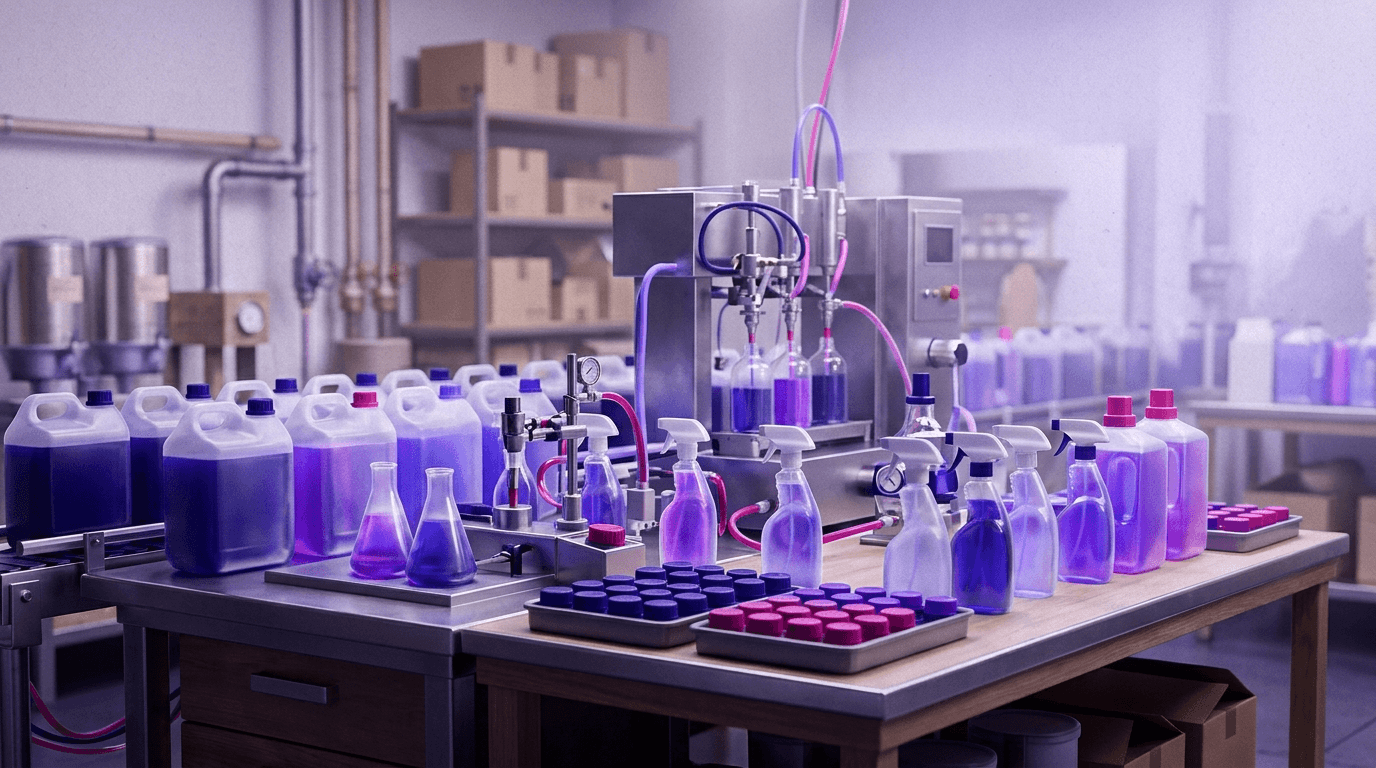
For small and medium-sized businesses filling cleaning products, liquid soaps, or surface cleaners, the apparent bulk of raw material costs consists of water and surfactants. However, the real price volatility and profit leakage happen elsewhere: bulk-purchased intense fragrances, preservative additives, HDPE plastic jugs, locking caps, and water-resistant labels.
Especially when filling 5-liter jugs or 1-liter bottles, packaging costs can approach or even exceed the cost of the liquid chemical inside. Moreover, when residue left at the bottom of the mixing tank, foam overflow, or liquid spilled from the filling nozzle is ignored, chemical stocks won't reconcile, and wholesale prices will remain unprofitable.
A Simple Formula and Filling Log Instead of Heavy Factory Systems
A filling workshop without hundreds of employees doesn't need the complex workflow approvals, machine shift schedules, or heavy setup costs of large enterprise resource planning systems. The production supervisor simply wants to quickly see how many jugs were filled from a mix, how much chemical waste occurred, and how many empty jugs are left in stock.
Qolay.App is a pre-accounting platform; thanks to its Production Management module, you can manage your formula recipes and packaging stocks from a single place. Chemical components are defined separately, while packaging items like jugs, caps, and labels are defined as Stock type additional costs. You can record every filling batch in seconds via the web and the iOS/Android mobile apps using the same screens.
Numerical Example: Cost of 100 Units of 5-Liter Lemon Surface Cleaner
Let's review the actual cost table for 100 units of 5-Liter Lemon Surface Cleaners (product unit: Piece) produced in a single batch at the filling facility. Active ingredients, water, fragrance, and additives are defined as components; tank bottom residue and fragrance evaporation loss are defined separately through the Enter Waste window; and the jug-label set, mixer electricity rate, and labeling labor are defined as additional costs:
| Cost Item | Qolay.App Item Type | Quantity × Unit Price | Total (TL) |
|---|---|---|---|
| Nonionic Surfactant | Component (0.40 kg/unit) | 40 kg × 110.00 TL | 4,400.00 TL |
| Deionized / Purified Water | Component (4.50 lt/unit) | 450 lt × 2.00 TL | 900.00 TL |
| Lemon Fragrance & Colorant | Component (0.03 kg/unit) | 3 kg × 650.00 TL | 1,950.00 TL |
| Preservative & Thickener Additive | Component (0.05 kg/unit) | 5 kg × 150.00 TL | 750.00 TL |
| Component Subtotal | Chemical Formula Total | 100 jugs net formula | 8,000.00 TL |
| Tank Bottom & Nozzle Filling Waste | Enter Waste Window | 1.50 kg Active (165 TL) + 0.10 kg Fragrance (65 TL) | 230.00 TL |
| 5L HDPE Jug + Cap + Front/Back Label | Additional Cost: Stock (× Quantity open) | 100 units × 32.00 TL | 3,200.00 TL |
| Mixer Electricity & Consumables (7%) | Additional Cost: Service–Rate (7%) | 8,000.00 TL × 7% (component base only) | 560.00 TL |
| Labeling and Boxing Labor | Additional Cost: Service–Amount (× Quantity closed) | Fixed batch labor amount | 510.00 TL |
| Grand Total & Jug Cost | 100 Units of Intact 5L Jugs | 12,500.00 TL ÷ 100 units | 125.00 TL/unit |
As seen in this calculation, the 3,200.00 TL jug and label cost makes up more than 25% of the total. The 7% electricity and consumables rate is applied solely to the 8,000.00 TL formula components, and the 230.00 TL filling waste and packaging expense are added to the total without inflating the percentage base. Thus, the actual unit cost of a 5-liter jug comes out to 125.00 TL.
Step-by-Step Control in Your Filling Facility with Qolay.App
- 1. Formula Recipe Setup (Production → Recipes): Open a single recipe for each product volume (500 ml, 1L, 5L, 20L). Add the chemicals to the Components tab using their units from the product card (
kg,lt). Save empty jugs, caps, and labels asStocktype ("Multiply by production quantity" checked), electricity/consumables share asService–Rate (%), and filling/labeling labor asService–Amount (TL). - 2. Filling Entry and Waste Log (Production → Production Entries): Once filling is complete, select the date, finished product, successfully filled jug count (100), and default company warehouse from a single form and save. Process tank cleaning or spill losses through the Enter Waste window. Even if you get an insufficient stock warning because a chemical's purchase invoice hasn't been entered yet, the record is not blocked; the negative balance is corrected once the invoice arrives. If e-commerce or marketplace stock integration is connected, the new jug stock is updated automatically.
- 3. Nighttime FIFO Engine, Production Slip PDF, and Reports (Production → Reports): Following the instant cost, the nighttime FIFO engine calculates the exact cost. You can get a customizable Production Slip PDF for the filling file; you can export Production Summary, Raw Material Consumption, Waste Report (up to 5,000 rows) for up to 366 days, and Recipe Cost reports showing your profit margin with the "Show margin" option to Excel. Admin/Standard users can write; Accountant or Read-Only users view and print all records.
4 Common Cost Mistakes in Cleaning Product Manufacturing
- Failing to Track Jugs, Caps, and Labels Separately: Calculating the liquid formula without deducting the packaging set from inventory disrupts warehouse counts and keeps selling prices too low.
- Rounding Fragrance and Additive Grams: Even a 10-gram overuse of expensive fragrances creates a serious cost difference in a 100-jug batch.
- Ignoring Tank Bottom and Foam Overflow Waste: Chemical residues not deducted via Enter Waste create ghost inventory that appears to be in the system but doesn't exist in the tank.
- Writing Zero for Purified Water and Filling Labor: When water purification consumables, electricity, and labeling labor—which seem like small amounts—are neglected, wholesale discounts wipe out profits.
Frequently Asked Questions
How should we proceed if we first prepare a 1,000-liter master mix and then fill it into 1L and 5L jugs?
There is no automatic sub-production in Qolay.App; instead, you first produce the master mix as a Semi-Finished Product and add it to inventory. Then, in the 1L and 5L finished product recipes, you define this semi-finished product as a component and the jug-labels as stock additional costs.
What happens if the raw material's purchase price hasn't been entered into the system yet?
If there is no remaining stock FIFO and latest purchase price, the system temporarily displays 0 TL and gives a "No cost" warning. When your purchase invoice is processed, the negative stock is corrected, and the nighttime FIFO engine updates the actual cost.
Is the stock of products we sell on marketplaces updated when production is entered?
Yes. As soon as the production entry is saved, the number of successfully produced jugs is added to stock, and the marketplace or e-commerce stock integration automatically reflects the new inventory.
Clarify Your Formula and Packaging Costs
Profitability in cleaning and detergent filling businesses relies on tracking every detail, from the chemical formula to empty jug stock, on the same platform. For the two-stage mixing-filling setup, you can check out our articles From Semi-Finished to Finished Product: Stock and Cost Tracking in Small Businesses Using Intermediates and for e-commerce stock synchronization Stock Synchronization in E-Commerce.
For details, visit the Qolay.App Production Management page and open a free account on Qolay.App right away to try out the module with an open trial period in Qolay Market.
This article is for general informational purposes. Tax legislation, accounting record regulations, and application details are updated periodically; consult your financial advisor for your business's specific situation.
Try it after reading
Start applying what you read with Qolay.App — for free.
Related articles
Other guides close to this topic.
Cooking Shrinkage and True Portion Profitability Calculation for Döner and Kebab Shops
Simple Control from Raw Meat Grams to Cooked Portion Cost
Learn how to calculate cooking and trimming shrinkage of raw meat, marinade expenses, lavash-box consumption, and true portion profitability in döner and kebab shops.
Filament, Resin, and Failed Print Waste in 3D Printing and Design Workshops
Including Support Structures, Electricity Duration, and Failed Prints in Costs
Calculate exact costs in 3D printing and prototyping workshops for filament, resin, brass inserts, electricity shares, and failed print waste with a single bill of materials and production entry.

What is the Ba-Bs Form, Is It Still Required?
The Silent Tool of Cross-Checking
Ba-Bs forms match your purchases and sales with the counterparty's declaration. We explained what they do, what happens when discrepancies arise, and the role of pre-accounting here.