

Sole, Upper, Adhesive, and Labor Costs in Small Footwear and Slipper Workshops
Learn how to track upper, thermo sole, inlining, adhesive, cutting waste, and shoe box costs in small shoe and slipper workshops with a single formula and production entry.
On this page
Why Do Unit Costs Quickly Fluctuate in Shoe and Slipper Workshops?
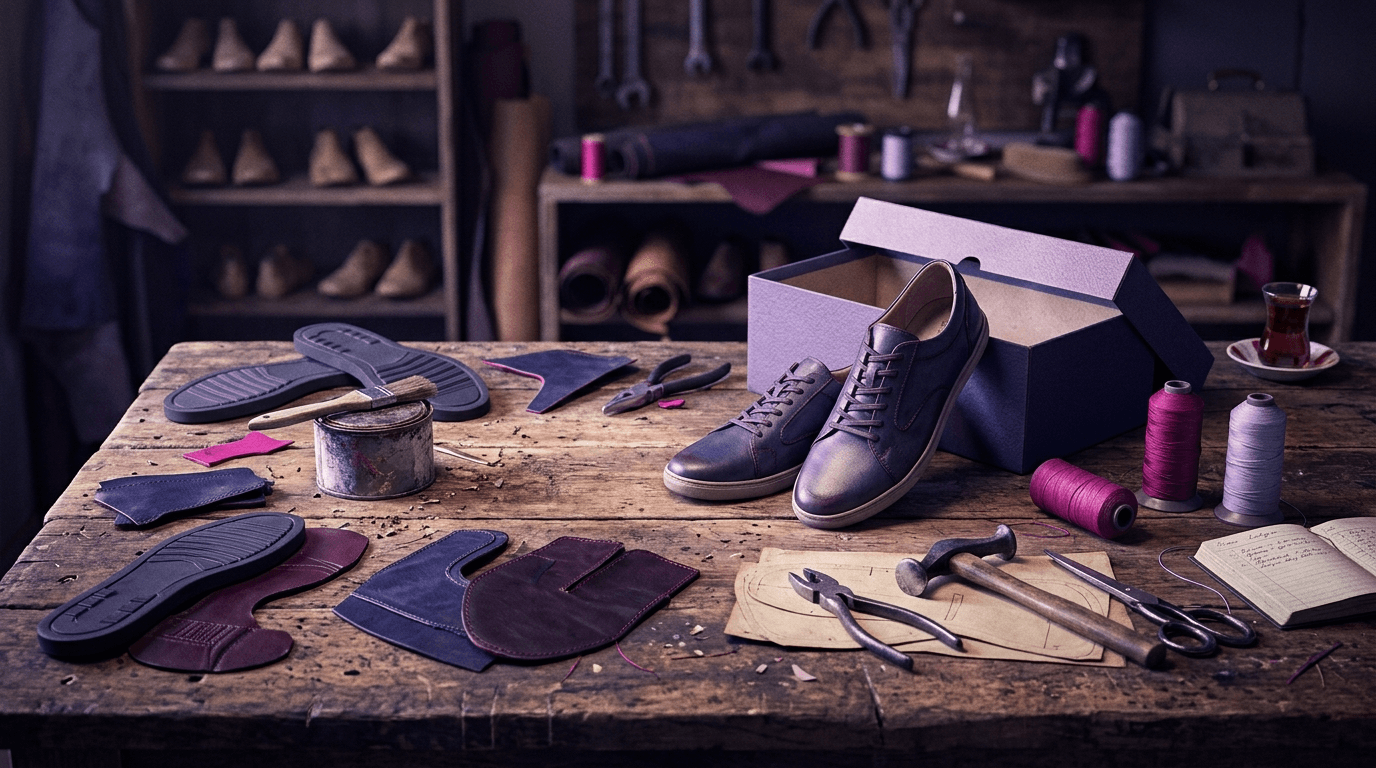
Season transitions are quite rapid in small and medium-sized shoe and slipper workshops in Turkey. On one side, there are uppers coming from the cutting room or contracted out for stitching; on the other, boxes of thermo or EVA soles, linings bought by the meter, polyurethane adhesives in kilogram tins, and size-labeled boxes. When quoting prices to wholesalers or e-commerce marketplaces, most workshop owners simply add a bit of labor to the "upper + sole" cost and set their price.
However, things on the production line do not go as smoothly as they do on paper. Adhesive tins dry up at the bottom, a pair of uppers gets torn in the press, or a sole melts at the wrong temperature and is scrapped. Moreover, items such as shoe boxes, tissue paper, size labels, and contracted assembly labor directly drive up the cost of every single pair. When these small differences are not tracked, almost all the profit can vanish even on an order of 100 assortments.
A Simple Recipe Workflow Instead of Heavy Production Software
Enterprise resource planning systems developed for large factories are far too heavy for a shoe workshop of 10–30 people, with their assembly lines, machine shift schedules, and multi-stage approval workflows. In the workshop, the master craftsman or business owner simply wants to enter the number of intact pairs produced at the end of the evening and see within seconds how many soles, uppers, and boxes were depleted.
Qolay.App is a pre-accounting platform and simplifies its Production Management module according to this workshop reality. You create a single recipe for each model; when production is completed, you record the number of sound pairs produced using a single production entry form. There are no complex unit conversions or automated sub-production chains in the recipe: if you stitch the uppers yourself, you first take them into stock as semi-finished goods; if they arrive ready-made from outside, you use them directly as raw materials. You can make instant records from inside the workshop using the same simple screen on the web or the iOS/Android mobile app.
Numerical Cost Table: 120 Pairs of Genuine Leather Daily Loafers Production
Let's examine the real cost calculation for 120 pairs of Genuine Leather Daily Loafers (product unit: Pair) produced in a single batch in a workshop. Here, cut leather uppers, thermo soles, inner lining, and adhesive are included as components; 2 pairs of uppers and 2 pairs of soles ruined during pressing are entered separately via the Enter Waste window; while the box-tissue set, workshop electricity rate, and assembly labor are entered with 3 different additional cost types:
| Cost Item | Qolay.App Item Type | Quantity × Unit Price | Total (TL) |
|---|---|---|---|
| Cut Leather Upper | Component (1 pair/pair) | 120 pairs × 260.00 TL | 31,200.00 TL |
| Thermo Ready Sole | Component (1 pair/pair) | 120 pairs × 115.00 TL | 13,800.00 TL |
| Inner Lining and Insole | Component (0.15 m²/pair) | 18 m² × 200.00 TL | 3,600.00 TL |
| Polyurethane Adhesive & Thread | Component (0.05 kg/pair) | 6 kg × 400.00 TL | 2,400.00 TL |
| Component Subtotal | Raw Material / Semi-Finished | 120 pairs consumption | 51,000.00 TL |
| Press Defect Upper & Sole | Enter Waste Window | 2 pairs Upper (520 TL) + 2 pairs Sole (230 TL) | 750.00 TL |
| Shoe Box + Tissue + Label | Additional Cost: Stock (× Quantity enabled) | 120 pcs × 25.00 TL | 3,000.00 TL |
| Oven, Press Electricity & Consumables | Additional Cost: Service–Rate (8%) | 51,000.00 TL × 8% (component base only) | 4,080.00 TL |
| Assembly and Stitching Labor Fee | Additional Cost: Service–Amount (× Quantity disabled) | Batch labor amount | 5,970.00 TL |
| Grand Total & Unit Cost | 120 Pairs of Sound Products | 64,800.00 TL ÷ 120 pairs | 540.00 TL/pair |
In this calculation, the 8% energy/consumables share of the Service–Rate (%) type is applied only to the component total of 51,000.00 TL; waste and stock-type box costs are not included in the rate base. When the total cost of 64,800.00 TL is divided by 120 sound pairs, the actual boxed pair cost becomes clear as 540.00 TL.
Step-by-Step Workshop Setup with Qolay.App
- 1. Recipe Preparation (Production → Recipes): After opening your model-based product card (default recipe quantity is 1 pair), enter the uppers, sole, lining, and adhesive into the Components tab with their units from the product card. Define the box and label as additional costs of type
Stock; this way, the "Multiply by production quantity" option is enabled by default, and your box stock is also deducted for each pair. Record labor asService–Amount (TL)and the workshop consumable share asService–Rate (%). - 2. Production Entry and Enter Waste (Production → Production Entries): At the end of the day or upon batch delivery, create the record by selecting the date, finished product, number of sound pairs produced, and default company warehouse. Record the uppers and soles ruined in the press or stitching with a description through the Enter Waste window. If the supplier's invoice has not arrived yet, the system gives an insufficient stock warning but does not block the record; the negative balance is closed when the purchase invoice is entered. If your produced shoes are linked to marketplace or e-commerce stock transfer, the new stock is automatically reflected on sales channels.
- 3. Receipt Printing and Profitability Tracking with 4 Reports (Production → Reports): You can get a customizable Production Receipt PDF for the workshop file. At the end of the month, you can filter and export Production Summary, Raw Material Consumption, Waste Report (up to 5,000 rows), and Recipe Cost reports (showing profit margin based on your sales price via "Show margin") to Excel for up to 366 days. Managers and Standard users can enter records, while Accountants and Read-Only users can view and print all cost and stock reports.
4 Frequently Made Cost Mistakes in Shoe and Slipper Workshops
- Treating Adhesive and Thread Consumption as Zero: When polyurethane glue, activator, and sewing thread are not written into the recipe, tin and spool expenses directly reduce profit.
- Excluding Boxes and Tissue Paper from Stock: If the box cost is not added per pair in e-commerce or wholesale parcel deliveries, the actual out-of-pocket cost appears at least 5% lower.
- Not Deducting Scrapped Uppers and Soles: If a pair of uppers torn in the mold or a burned sole are not deducted via Enter Waste, the sole-upper balance in warehouse counts gets distorted.
- Calculating Leather and Sole Price Hikes with Old Prices: Failing to update the newly arrived hiked sole or leather costs via FIFO after the remaining old stock runs out leads to miscalculated new season prices.
Frequently Asked Questions
How should we track if we cut and stitch the uppers in our own workshop?
First, you create a Cut Upper (Semi-Finished) recipe with leather and lining components and take the upper into stock with a production entry. Then, you use this semi-finished product as a single component in the shoe finished-product recipe.
Is the cost in the production entry finalized during the day?
At the moment of recording, instant cost is calculated in the order of FIFO remaining stock, last purchase price, or 0 ("No cost" warning). The FIFO engine running at night scans all stock movements and finalizes the actual cost.
What should I do if assembly labor turns out higher than expected in a batch?
You can directly edit the additional cost line on that batch's Production Entry screen or add a new line; your main recipe will not be affected by this.
Clearly See the Profit of Every Pair in Your Workshop
Your competitiveness in shoe and slipper production is measured by knowing the actual pair cost behind the price you quote to the wholesaler or marketplace. For cost dynamics on the textile and sewing side, you can check out our article on Cost Tracking in Textile and Apparel Workshops and our guide on 5 Hidden Cost Items That Quietly Erode Profit in Small Manufacturers.
To streamline your workshop processes, check out the Qolay.App Production Management page and open a free account on Qolay.App right away to test the module currently offering a trial period in Qolay Market.
This article is for general informational purposes. Tax legislation, accounting record regulations, and implementation details are updated periodically; consult your financial advisor for your business's specific situation.
Try it after reading
Start applying what you read with Qolay.App — for free.
Related articles
Other guides close to this topic.
Before Returning to the Computer: Mobile Production Entry and Fire Log in the Workshop
Instant Inventory and Cost Tracking on iOS and Android with the Same Screens as the Web
Use the Qolay.App mobile app for iOS and Android to enter production data and record "Fire Gir" entries in the workshop or kitchen; view the real-time cost without having to go back to your computer.

What to Do If Raw Material Stock Drops to Negative During Production Entry?
Invoice Delay, Opening Stock, and Nighttime FIFO Cost Correction
Learn how to continue your workflow without locking it when raw materials drop to negative stock during production entry, and how to fix it using purchase invoices and the nighttime FIFO engine.

Factoring and Receivables Discounting: How to Calculate the True Cost?
Protecting Profitability While Converting Post-Dated Checks and Invoices into Cash Early
Explore how to calculate factoring and receivables discounting costs, check-discounting processes, and methods to protect profitability on the Qolay.App corporate blog.