

Purchase Order Process: Requisition, Quotation, Receiving, and Invoice Matching
Discover the purchase order, supplier tracking, and 3-way matching method in full detail on the Qolay.App corporate blog.
On this page
Stop Leakages in the Purchasing Process
One of the most critical cost items in your business's growth journey is the raw materials, semi-finished goods, trade goods, and services procured from outside. As your volume grows, purchasing processes managed through traditional methods eventually become unmanageable. When the answers to questions like which department requested what and when, which offer was approved, what was actually received in the warehouse, and how the incoming invoice aligns with this cycle are lost, your business's profitability begins to erode insidiously.
Blindly approving and paying every invoice that arrives at your pre-accounting department is a major mistake frequently encountered in the market, yet it deeply undermines financial health. Paying invoices for goods that were delivered short, transferring resources to suppliers for unordered products, or failing to notice price increases outside of contracts directly endangers your business's cash flow. This is exactly where it becomes vital to establish rules for the purchase order process and place the 3-way matching mechanism at the center of your corporate operations.
What is Purchasing and 3-Way Matching?
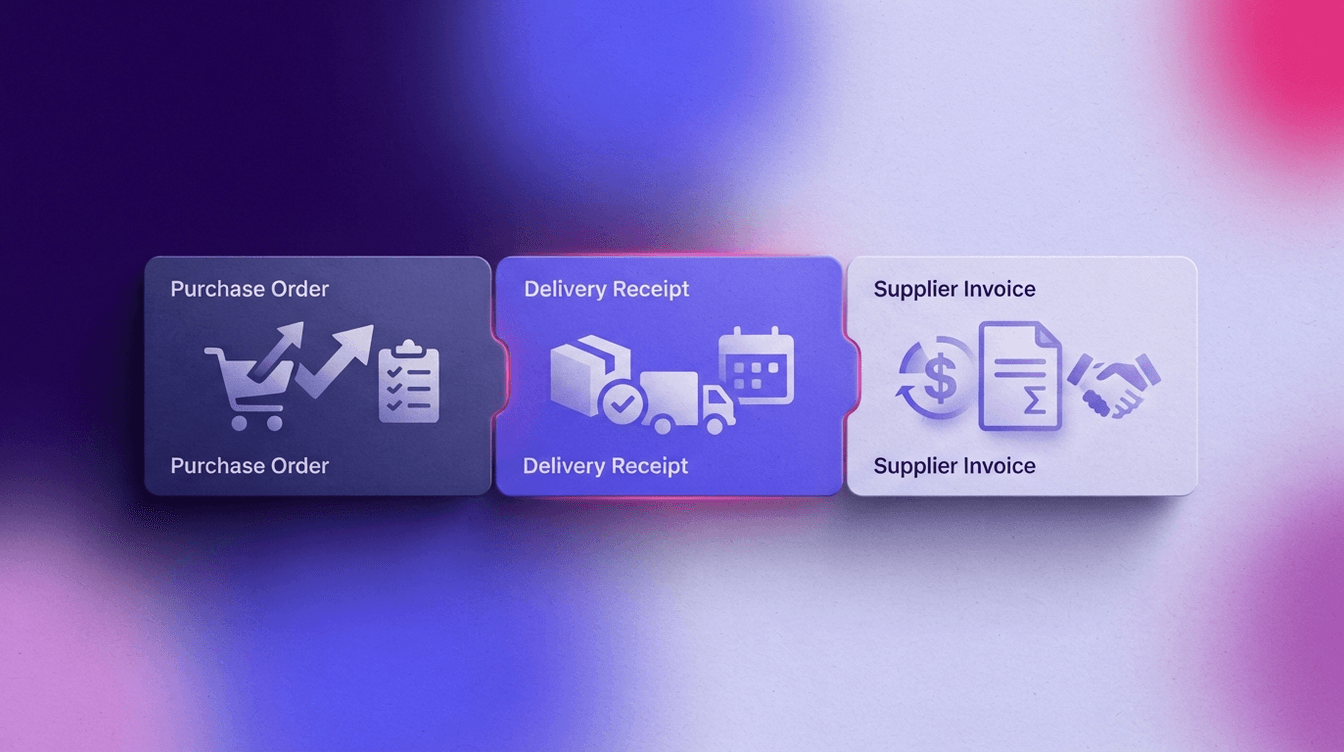
3-way matching is the process of verifying the purchase order document created by the purchasing department, the receiving document (or e-waybill) issued by the warehouse or goods acceptance unit, and the invoice issued by the supplier by cross-checking them against each other. This method is the most reliable, globally accepted standard for preventing erroneous or fraudulent payments in pre-accounting and financial operations.
For a purchasing process to be built on solid foundations, these three basic documents must match perfectly:
- Purchase Order (PO): The official commitment document showing which product your business ordered, in what quantity, at what unit price, and under what conditions.
- Goods Receipt / Receiving Document (e-waybill): The document proving that the goods have been checked for quantity and quality and received when they physically enter the warehouse.
- Supplier Invoice: The document issued by the supplier after the delivery of goods or services, which has financial value and will be transferred to accounting records.
A Realistic Case Scenario for SMEs: 3-Way Matching Saves Lives
Let's consider an SME in packaging manufacturing with an annual turnover of 15 million TL. This business regularly procures cardboard raw materials for its production line. In the traditional setup, the production manager tells the supplier over the phone, "Send 100 boxes of cardboard." The supplier drops the goods at the factory, the waybill paper is thrown onto the desk, and a week later, the invoice issued by the supplier is sent directly to pre-accounting. The pre-accounting staff then makes the payment by looking at the amount on the invoice.
However, after the business switches to software-based 3-way matching processes, the same scenario works as follows:
- Order Control: In the PO document entered into the system based on the purchase requisition form, the unit price of 100 boxes of material is formalized at 250 TL (Total: 25,000 TL + VAT).
- Goods Receipt Control: The warehouse clerk scans the incoming e-waybill and counts the boxes; however, due to a glitch during shipment, they detect that only 90 boxes entered the warehouse and update the system to 90 boxes.
- Invoice Matching: The supplier, out of routine billing habit, reflects the 25,000 TL invoice for 100 boxes into the system. Integrated systems like Qolay.App instantly catch the discrepancy between the PO document (100 units), the goods receipt report (90 units), and the invoice amount with a red warning.
- Financial Savings: Thanks to the automatic warning, the pre-accounting team avoids overpaying the supplier for the 10 missing boxes (2,500 TL). The supplier corrects their erroneous invoice, and the business protects its cash flow.
Purchasing Process Steps and Comparison Matrix
The orderly execution of purchasing operations relies on transparent communication between departments and strict control. The table below provides a comparative analysis of the traditional/disorganized purchasing process versus the professional 3-way matching-supported process.
| Process Stage | Traditional / Disorganized Method | Professional 3-Way Matching Method |
|---|---|---|
| Requisition and Approval | Verbal or via email, uncontrolled | Formal requisition and authority matrix via system |
| Order Creation | Informal via phone or WhatsApp | Written Purchase Order (PO) approval |
| Goods Receipt | Unloading to warehouse without counting | Comparison of waybill and actual quantity count |
| Invoice Payment | Direct payment of the incoming invoice | PO + Waybill + Invoice cross-check and approval |
| Budget and Limit Control | Budget overrun unnoticed, surprise costs arise | Department-based spending limits tracked instantly |
| Archiving and Reporting | Documents lost in physical folders | Access in seconds in digital cloud archive |
This table clearly reveals how much financial risk disorganized processes expose your business to. In a professional structure, each step verifies the previous one, and the payment stage cannot be reached without system approval.
Step-by-Step Purchasing and Matching Order in Pre-Accounting
To perfect your pre-accounting processes and protect your cash flow, the operational steps you should follow are:
- 1. Purchase Requisition: The department in need opens a written request and forwards it to the approving authority.
- 2. Price Quotation and Supplier Selection: Offers are collected from suppliers for the approved request; the most suitable supplier is selected by taking current account tracking data into account.
- 3. Formalization of the Order: An official Purchase Order is sent to the selected supplier.
- 4. Goods Receipt and Control: When the products reach the warehouse, the items on the waybill are counted one by one and processed into the system.
- 5. 3-Way Matching and Payment Planning: When the supplier invoice reaches accounting, it is matched with the order and waybill data; then, it is safely added to the payment plan in accordance with the report of receivables and payables.
Common Mistakes and Financial Risks
The traps that SMEs fall into most frequently in purchasing processes and ways to avoid these traps are as follows:
- Working Without an Order Document: Verbal orders pave the way for the supplier to send the wrong product or apply unexpected unit prices. Every order must be tied to a written PO document.
- Not Counting During Goods Receipt: Accepting delivery without checking the contents of the boxes arriving at the warehouse leads to paying for missing or damaged products.
- Skipping Invoice Control: VAT rates, discount amounts, and unit prices on the incoming invoice should not be approved directly without being compared with the order confirmation.
- Lack of Authorization: Allowing every employee within the company to spend from any supplier they wish causes off-budget costs to increase.
- Archive Confusion: Storing e-invoices and e-waybills in disorganized folders creates time loss during tax audits.
Frequently Asked Questions
Is 3-way matching mandatory for small businesses?
Although not legally mandatory, it is a vital operational security shield for all businesses, regardless of scale, in terms of financial discipline and preventing cash leakages.
What should be done if the order quantity and invoice quantity do not match?
If the invoice amount is higher than the order or waybill quantity, payment should definitely not be approved; the supplier should be contacted, and a difference invoice or return process should be initiated.
How is 3-way matching done for service purchases?
Instead of a physical waybill, a service acceptance report or work completion certificate proving that the service was received fully and completely is matched with the order and invoice.
Should I track these processes manually or with software?
While Excel tables are sufficient to a point, as your business volume increases, using integrated pre-accounting and cloud-based software is essential to zero out the margin of error.
If the supplier reflects a currency difference in the invoice amount, how is it managed in 3-way matching?
In foreign currency-based orders, differences arising from exchange rate changes should be cross-checked with original PO conditions and contract clauses and reflected in the system with the special approval of the finance manager.
If the supplier sends the remaining product later after a partial delivery, does the process start over?
No, the process is completed safely by closing the partial delivery with an additional waybill over the existing open PO record, and the risk of duplicate billing is prevented.
The Final Step for Operational Excellence
To bring discipline to your purchasing processes, conduct your supplier relationships transparently, and completely eliminate the risk of overpayment, open a free account on Qolay.App to digitize your pre-accounting today and secure your business's financial future.
This article is for general information purposes. Tax legislation, notification thresholds, and application details are updated periodically; consult your financial advisor and GİB announcements for the status of your own business.
Try it after reading
Start applying what you read with Qolay.App — for free.
Related articles
Other guides close to this topic.

Converting Marketplace Orders to Invoices
Pull the Order, Let the System Generate the Invoice
Invoicing orders one by one from Trendyol, Hepsiburada, and other marketplaces takes days. We explained how to set up the store connection, how orders are converted into invoices, and their impact on stock.

How to Invoice Advances and Prepayments?
Money Received, But the Job Isn't Done
You collected an advance; should you issue an invoice? We explained why an advance alone does not trigger an invoice, the difference between a deposit and an advance, and the offsetting process.

Installment Sales and Payment Plan Tracking
When Splitting the Invoice Across Months
The real challenge in installment sales isn't issuing the invoice, but chasing down every due date. We explained how to set up an installment plan and match it with collections.