

Portion Recipe, Box, and Tray Cost in Bakeries and Dessert Workshops
Track semi-finished cream, packaging boxes, and baking waste in a single system for bakeries and dessert workshops; calculate your exact portion cost down to the last penny with Qolay.App.
On this page
Hidden Details That Melt Profits in Bakeries and Dessert Workshops
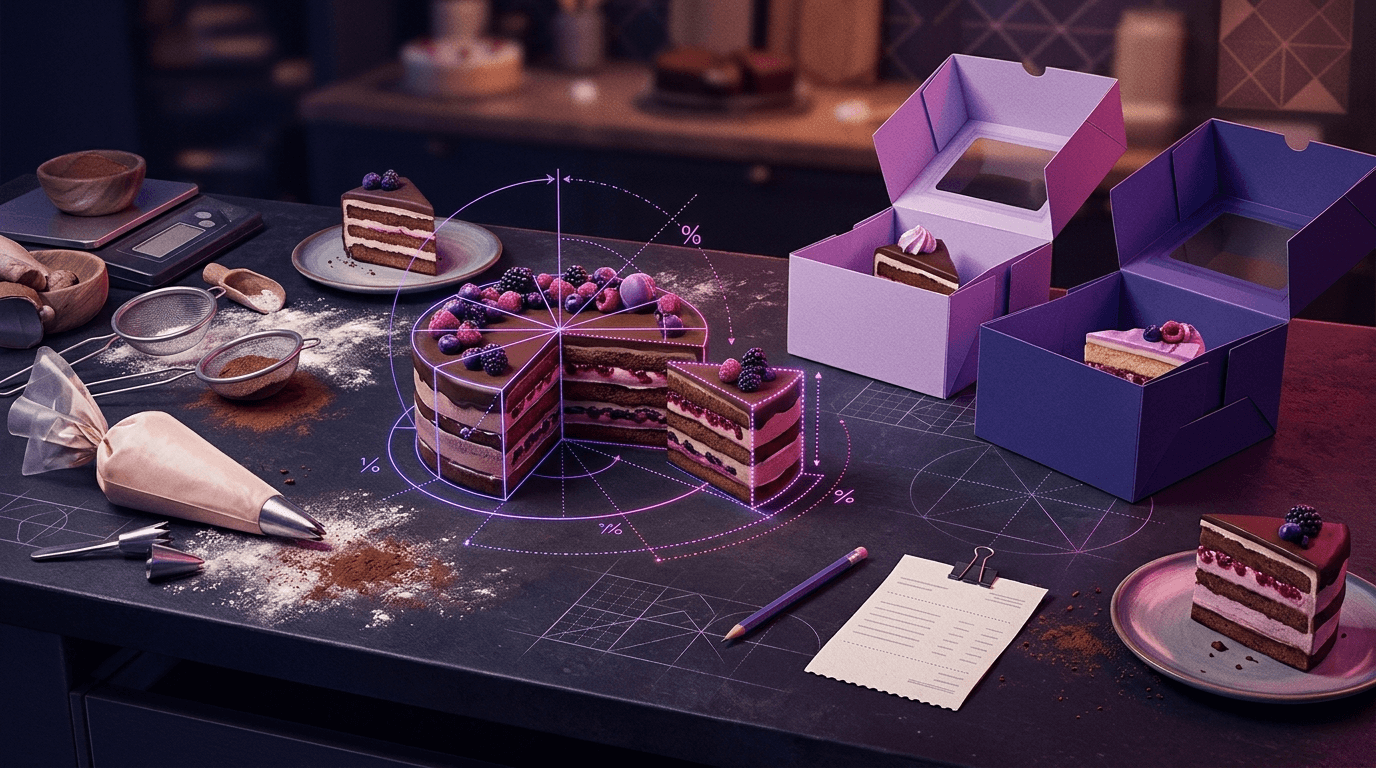
With the first light of morning, butter, fresh cream, fruit, and flour are brought to the counter; by noon, display cases fill up and takeout boxes are prepared. Yet, many bakery and dessert workshop owners wonder why profitability doesn't reach expected levels at the end of the month, even though the cash register looks full. The root of the problem is often focusing solely on flour and sugar prices while failing to add boxes, cake boards, oven energy, prepared semi-finished creams, and portions that crack or get crushed on the tray into the cost.
Especially in boutique bakeries, workshops producing tarlets and éclairs, or production facilities sending wholesale tray desserts to cafes, there is a two-layered structure: First, semi-finished products such as pastry cream or ganache are prepared in large pots, and then these creams meet the base dough and fruits to turn into the final portion. Managing this chain with a paper notebook or rough estimates leads to secretly losing money per portion with every price hike on butter or fruit.
Why Simple Recipes and Production Entries Instead of Heavy ERP and MRP?
Heavy ERP and MRP software designed for large factories do not fit the daily pace of a bakery workshop. The master baker or business owner in the kitchen doesn't want to deal with multi-stage approval screens, complex station planning, and long setup tables for every tray of dessert. What you need is a lean structure that talks directly to your pre-accounting setup.
Qolay.App is a pre-accounting platform, not a corporate ERP system. The Production Management module also works with this simple logic: Web and mobile (iOS/Android) screens are the same, proceeding through a single warehouse (default company warehouse). You define a single recipe per finished product; when production occurs, you make the production entry in a single form as a single record. If you are using semi-finished products, you first enter the production of the semi-finished product (for example, pastry cream) and then record the final dessert production. Thus, raw material stock decreases, finished product stock increases, and unit cost emerges without disrupting the kitchen routine.
Realistic Scenario: Cost Table for 30 Raspberry Tartlets
Let's assume that 30 Raspberry Tartlets are produced in the morning batch at a bakery workshop. First, the Pastry Cream (kg) semi-finished product was produced in the kitchen and taken into stock. Then, the tartlet recipe was defined for 1 finished product and a production entry for 30 units was made. Whatever units are selected in the product cards (kg and units), the recipe and consumption are processed with the same units.
| Cost Item | Category | Quantity / Calculation | Amount (TL) |
|---|---|---|---|
| Pastry Cream (Semi-Finished) | Component | 30 × 0.10 kg = 3.00 kg × 200 TL | 600.00 TL |
| Buttery Flour Mix | Component | 30 × 0.10 kg = 3.00 kg × 150 TL | 450.00 TL |
| Fresh Raspberries | Component | 30 × 0.05 kg = 1.50 kg × 300 TL | 450.00 TL |
| Raw Material Total | Subtotal | 600 + 450 + 450 | 1,500.00 TL |
| Oven Energy & General Kitchen | Additional Cost (Service–Rate) | Raw materials only (1,500 TL) × 10% | 150.00 TL |
| Master Preparation & Decoration Share | Additional Cost (Service–Amount) | Fixed per batch (multiply disabled) | 300.00 TL |
| Tartlet Box + Cake Board | Additional Cost (Stock) | 30 units × 12 TL (multiply enabled) | 360.00 TL |
| Crushed Fresh Raspberries | Enter Waste | 0.30 kg × 300 TL (not included in 10% base) | 90.00 TL |
| Total Production Cost | Grand Total | 1,500 + 90 + (150 + 300 + 360) | 2,400.00 TL |
| Unit Portion Cost | 30 Intact Units | 2,400.00 ÷ 30 | 80.00 TL / unit |
The critical detail in the table is this: The 10% energy additional cost is calculated solely over the raw material total of 1,500 TL (150 TL). The crushed raspberry waste amount (90 TL) and box stock additional cost (360 TL) are not included in the percentage base, but are added directly to the total cost. Thus, the real cost of each tartlet becomes clear as 80.00 TL.
Step-by-Step Bakery Application with Qolay.App (Web + Mobile)
Whether from the tablet in the workshop or the computer at the register, you can complete your setup in minutes using the same screens:
- 1. Define Recipes (Production → Recipes): First, save the recipe consisting of milk, egg yolk, starch, and sugar for the Pastry Cream semi-finished product. Then, select the Raspberry Tartlet finished product, leave the recipe quantity at 1 unit, and add the Pastry Cream, Buttery Flour Mix, and Fresh Raspberries rows to the Components tab.
- 2. Link Additional Costs: In the Additional Costs tab of the recipe, add 10% oven energy as Service–Rate, 300 TL master preparation share as Service–Amount (multiply by production quantity option disabled), and the Tartlet Box + Board item as Stock (multiply by production quantity option enabled).
- 3. Make the Production Entry (Production → Production Entries): First, enter the production of the semi-finished Pastry Cream. Then open the Raspberry Tartlet production form, enter the date and the produced intact quantity (30 units); the recipe rows will come automatically.
- 4. Record Waste Separately (Enter Waste): Record the 0.30 kg of raspberries crushed on the counter from the Enter Waste window without inflating the consumption row. As soon as you save it, raw material, waste, and box stocks are deducted from the warehouse; 30 tartlets are entered into stock. If stock is insufficient, the system warns but does not block production; entering the incoming purchase invoice later will correct negative stock.
- 5. Check with Slips and Reports (Production → Reports): Print the customizable Production Slip PDF document. After the FIFO engine running at night finalizes the cost, open the "Show margin" option in the Recipe Cost report to monitor your real profit margin based on your display sales price.
Top 5 Cost Mistakes Made in Bakeries and Dessert Workshops
- Counting Boxes, Ribbons, and Boards as "General Expenses" and Forgetting Them: If cake boxes and gold-foiled boards costing 12–20 TL each are not added to the recipe as Stock-type additional costs, the margin on takeout sales looks high on paper but actually melts away.
- Entering Semi-Finished Product Costs by Estimation: Writing a fixed price for the finished product without creating recipes for intermediate products like ganache, praline, or pastry cream prevents you from seeing milk and chocolate price hikes.
- Embedding Baking and Fruit Peeling Waste into the Recipe: Incorporating waste directly into recipe consumption confuses normal consumption with loss. Entering waste separately allows you to see which raw material suffered losses and why via the Waste Report.
- Setting Up Recipes with Unit Incompatibility: Confusing a material that comes as kilograms on the purchase invoice with a product card opened in gram units skews the cost by 1,000 times. Since there is no unit conversion in the first version, care must be taken to ensure the purchase invoice and recipe units are the same.
- Leaving the Multiply Option Wrong in Service–Amount Additional Costs: If "Multiply by production quantity" is left enabled by mistake for a 300 TL per-batch master cost, 9,000 TL of labor is written for 30 units and the portion cost is completely ruined.
Frequently Asked Questions
Are semi-finished products like pastry cream produced automatically when desserts are produced?
No, there is no automatic multi-level sub-production. First, the production entry of the semi-finished product (e.g., Pastry Cream) is made, and then this semi-finished product is consumed as a component in the final tartlet or cake recipe.
Do I need to break the main recipe if an order requires a special box or extra decoration?
You don't need to. On the Production Entries screen, you can edit additional cost rows specific to that production, add new additional costs, or remove them. Your main recipe remains intact.
Can a master baker or cashier enter production, and what can the financial advisor see?
Manager and Standard authorized users can define recipes and make production entries. Accountant and Read-Only authorized users can view records and reports and print the Production Slip PDF.
Can I enter production if the raw material purchase invoice hasn't been processed yet?
Yes. When stock is insufficient, the system gives a warning but does not block the record. When you enter your purchase invoice into the system later, the negative stock is corrected and the FIFO engine running at night finalizes your unit cost.
Clearly See the Profit of Every Tray and Every Box
To protect your margin both in display sales and takeout channels in your bakery, you need to regularly monitor tray, box, and semi-finished product costs. For more details on the subject, you can review the Qolay.App Production Management features page; for complementary information regarding the sector, you can check out our articles on Pre-Accounting and Food Cost Control for Restaurants and Cafes and Waste, Loss, and Spoiled Stock Recording. The Production Management module is offered as a separate add-on through Qolay Market and can be tested with a trial period. You can start managing your recipes and production costs from a single screen right away by opening a free account on Qolay.App.
This article is for general informational purposes. Consult your financial advisor for tax legislation, accounting practices, and cost accounting requirements specific to your business.
Try it after reading
Start applying what you read with Qolay.App — for free.
Related articles
Other guides close to this topic.
Qolay.App Production Management: Recipes and Costs in 3 Steps for Small Manufacturers
Simple Recipes, Production Entry, and Reporting for Workshops, Cafes, and E-Commerce Manufacturers
Learn how to create recipes, enter production data, track waste, and analyze unit costs in three steps with the Qolay.App Production Management module, developed for small and medium-sized businesses.
Raw Material Cost Management for Healthy Snack, Granola, and Bar Manufacturers
The Impact of Dates, Nuts, Cutting Waste, and Barrier Packaging on Unit Cost
Manage high-priced inventory of nuts, dates, cutting waste, and flowpack packaging with Qolay.App for healthy snack, granola, and protein bar manufacturers.