

Recipe and Packaging Inventory Tracking in Spice and Herbal Tea Blend Workshops
Learn how to track blend ratios, sifting and stem-removal waste, and zip pouch and label costs with simple basic accounting in spice and herbal tea blending workshops.
On this page
Herbs in Sacks, Blends Packed by the Gram, and Lost Dust
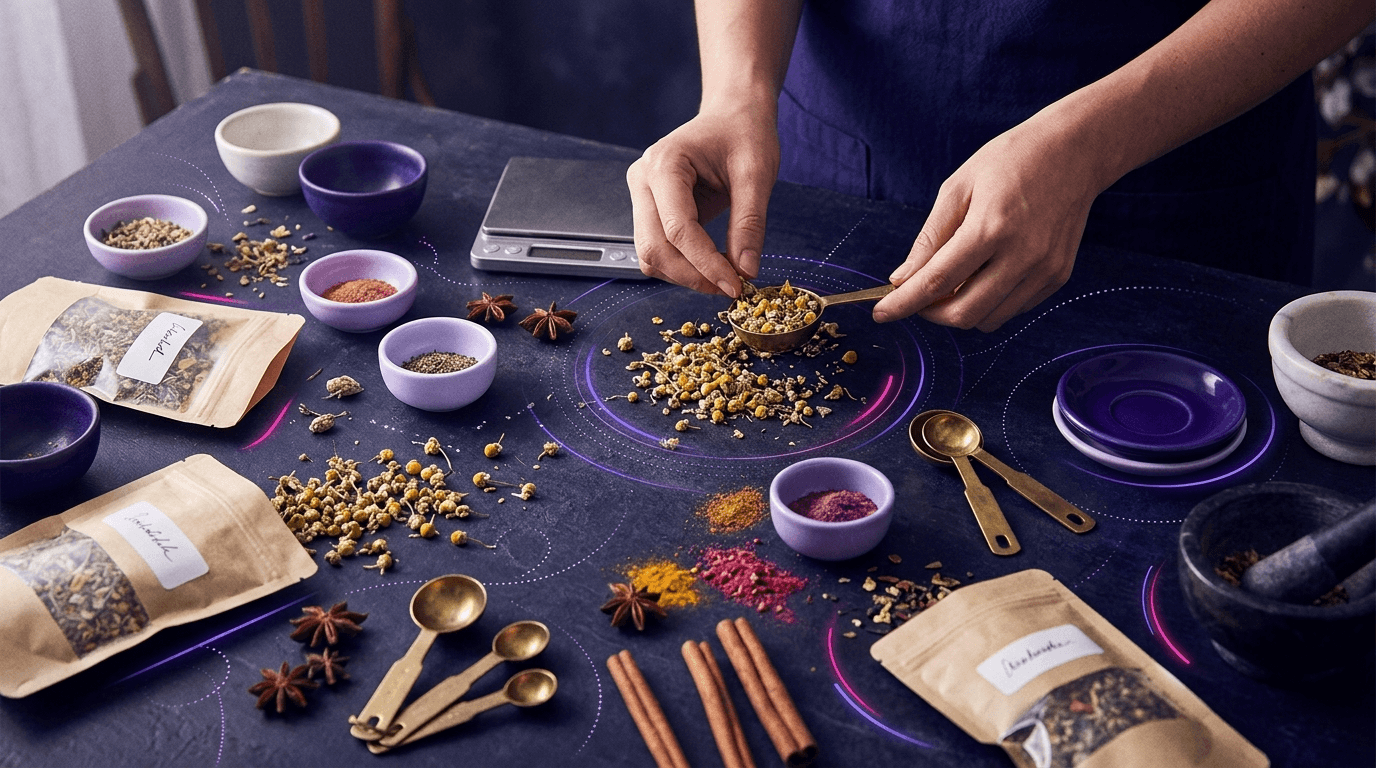
In small workshops that prepare spices, meatball seasoning mixes, special sauce powders, and herbal tea blends for herbalists, gourmet markets, or e-commerce marketplaces, cost tracking has two challenging sides. The first is the sifting and dust waste generated when bulk sacks of dried linden, rosehip, thyme, or ginger are sieved and separated from their stems. The second is the simultaneous consumption of packaging—such as kraft ziplock doypack pouches, front/back brand labels, and protective boxes—alongside four to five different herbal raw materials in even a single 100-gram package.
Although blend ratios are kept on paper in these workshops, managing packaging inventory and dry herb inventory disconnected from each other often leads to situations where, on the day of an order, you have linden flowers but have run out of ziplock pouches, or stock balances don't match due to sifting loss. Moreover, when price hikes on packaging go unnoticed in marketplace sales, margins erode rapidly.
Why Simple Recipes + Packaging Deduction Instead of Heavy Food ERPs?
Heavy ERP and MRP systems built for industrial spice factories demand silo weighing automation, shift planning, work order approval chains, and complex lot tracking screens. For a 3 to 20-person blending and packaging workshop, this setup slows down daily production. What a small producer needs is to create a single recipe for each tea or spice mix and, once packaging is complete, deduct all herbs along with bag and label inventory with a single click.
Qolay.App is a pre-accounting platform. Its Production Management module offers the same simple screens on both the web panel and the iOS/Android mobile apps. It processes stem and dust loss generated during blend sifting through a separate Enter Waste window without disrupting the standard recipe; you can also define kraft pouches and labels as Stock-type extra costs to automatically deduct them from inventory with every package.
Sample Cost Table: 300 Packs of 100g Winter Detox Herbal Tea Blend
Let's assume a tea workshop produces 300 packs of 100g Winter Detox Herbal Tea. Since all dry herbs are measured in kg, they are entered in the recipe in kg units (0.035 kg, 0.030 kg, etc.). The 1.20 kg linden loss from sifting and stem removal was added via Enter Waste; blending labor was calculated as Service–Rate, sieve/mixer cleaning as Service–Amount, and doypack kraft pouch + label set as a Stock extra cost.
| Item Type | Material / Expense | Quantity (For 300 Packs) | Unit Price | Total Amount |
|---|---|---|---|---|
| Raw Material | Dried Linden Flower (0.035 kg/pack) | 10.50 kg | 540.00 TL | 5,670.00 TL |
| Raw Material | Crushed Rosehip (0.030 kg/pack) | 9.00 kg | 220.00 TL | 1,980.00 TL |
| Raw Material | Dried Ginger and Cinnamon (0.020 kg/pack) | 6.00 kg | 380.00 TL | 2,280.00 TL |
| Raw Material | Orange Peel and Hibiscus (0.015 kg/pack) | 4.50 kg | 320.00 TL | 1,440.00 TL |
| Subtotal | Raw Material Total | - | - | 11,370.00 TL |
| Enter Waste | Sifting Dust and Stem Removal Waste | 1.20 kg (Linden) | 540.00 TL | 648.00 TL |
| Service–Rate | Blending, Sifting, and Weighing (10%) | 11,370.00 TL × 10% | - | 1,137.00 TL |
| Service–Amount | Sieve and Mixer Cleaning (multiplication disabled) | 1 batch | 450.00 TL | 450.00 TL |
| Stock Extra Cost | Ziplock Doypack Kraft Pouch + Label | 300 pcs (multiplication enabled) | 11.00 TL | 3,300.00 TL |
| Total | 300 Packs of Finished Herbal Tea | Unit: 56.35 TL/pack | - | 16,905.00 TL |
In the calculation, the 10% Service–Rate labor amounts to 1,137.00 TL based solely on the raw material total of 11,370.00 TL; the 648.00 TL sifting waste and 3,300.00 TL kraft pouch-label inventory are not included in the percentage base. A total unit cost of 56.35 TL is obtained by dividing 16,905.00 TL by 300 packs.
Step-by-Step Tracking in Spice and Tea Workshops with Qolay.App
- 1. Set Up the Recipe (Production → Recipes): Open a single recipe for each tea and spice blend package. If the herb cards are in kg units, enter decimals in kg in the recipe (e.g., 0.035 kg). If you first produce a bulk semi-finished product like "Winter Tea Bulk Blend" in a large sack and then divide it into 50g, 100g, and 250g pouches, since there is no automatic sub-production, first produce the bulk blend semi-finished product, and then use this semi-finished product in your packaging productions.
- 2. Post-Packaging Production and Sifting Waste (Production → Production Entries): Enter the number of sealed and labeled finished packages. Process the stem, debris, and sifting dust loss through the Enter Waste window. While the ziplock pouch and label inventory are automatically deducted, 300 packs of finished goods enter the inventory, and the marketplace stock integration instantly reflects the new stock.
- 3. Production Slip PDF and FIFO Update: The instant cost is calculated at the time of recording, and the FIFO engine running at night determines the exact cost based on which purchase sack the deduction was made from. You can get a customizable Production Slip PDF for your workshop file.
- 4. Supply and Margin Reports (Production → Reports): Plan your seasonal herb orders with Raw Material Consumption (which you can filter up to 366 days), see which supplier's herbs generate more stems/debris with the Waste Report, and keep your selling prices up to date with Recipe Cost ("Show margin").
5 Common Mistakes in Spice and Herbal Tea Workshops
- Failing to Record Stems and Sifting Dust as Waste: If the sifting loss coming out of the sack—especially in linden, sage, and thyme—is not deducted, inventory looks artificially high on paper.
- Forgetting Kraft Pouches, Labels, and Oxygen Absorber Packets: In small-grammage products, packaging costs can exceed the cost of the herb itself; they must be deducted as stock extra costs.
- Breaking Unit Consistency: If you purchase herbs in kg and enter "35" as grams in the recipe, the system will deduct 35 kg; the card unit and recipe unit must match.
- Pulling Costs Without Entering the Invoice for Herbs Purchased from Farmers: When document entries are missing, components appear as 0 TL with a "No cost" warning; purchase documents must be processed.
- Combining 50g and 250g Packages of the Same Blend into a Single Card: Each grammage consuming different pouches and labels must be tracked with a separate finished good card and recipe.
Frequently Asked Questions
How do I track if I prepare a 50 kg blend first and package it across multiple days?
You open a semi-finished product card and recipe named "Winter Tea Bulk Blend" and produce 50 kg of the blend at once. On subsequent days, when producing 100g or 250g pouches, you use this semi-finished product along with pouch/label inventories as components.
Can I make a packaging entry if herbal tea pouch inventory drops into the negative?
Yes. The system warns you when stock is insufficient but doesn't block the record; negative stock is resolved once you enter your pouch purchase invoice.
How does my accountant see which herb and how much was consumed at the end of the month?
Accountants or users with Read-Only permissions can view the Raw Material Consumption and Waste Report under Production → Reports and export them as Excel.
Flawless Tracking from Blend to Ziplock Pouch
Managing blend ratios, sifting waste, and packaging inventory on the same screen in spice and herbal tea workshops puts an end to stock surprises and reveals the true profit of every package. You can activate the Production Management add-on module in Qolay Market during your free trial and test your recipes. For details, you can visit the Qolay.App Production Management page and check out our guides on What is an e-Producer Receipt? and Stock Synchronization in E-Commerce.
Open a free account on Qolay.App to start managing your blend recipes and pouch inventories right away.
This article is for general informational purposes. Food packaging rules, VAT rates, and producer legislation may vary depending on your business; consult your accountant.
Try it after reading
Start applying what you read with Qolay.App — for free.
Related articles
Other guides close to this topic.

Preparation for Tax Audit and Digital Risk Analysis (e-Audit)
Pre-Accounting Robustness Against GİB Cross-Checks
Learn how to protect your business against GİB e-Audit and Risk Analysis Center cross-checks. Strengthen your pre-accounting processes against digital risks starting today.

What is the Renewal Fund? Tax Deferral on Fixed Asset Sales Profit
The 3-Year Rule and Advantages in Purchasing New Machinery/Vehicles
Instead of taxing the profit arising from the sale of your business's fixed assets, defer it for 3 years with the Renewal Fund. All details and accounting practices under VUK 328 are in this guide.

How to Prepare and Read a Monthly Profit & Loss (P&L) Management Report?
Extracting Decisions from Gross Profit, Operating Profit, and Net Profit Lines
A guide on preparing a monthly profit-and-loss report and reading gross, operating, and net profit items to safeguard your business's financial health.