

Oil, Essence, Bottle, and Label Costs in Natural Soap and Cosmetics Workshops
Unit cost calculation guide for natural soap and cosmetics workshops, including fixed oils, essential essences, glass bottles and pumps, waterproof labels, and filling waste.
On this page
The Cost Difference of Grams and Bottles in Natural Cosmetics
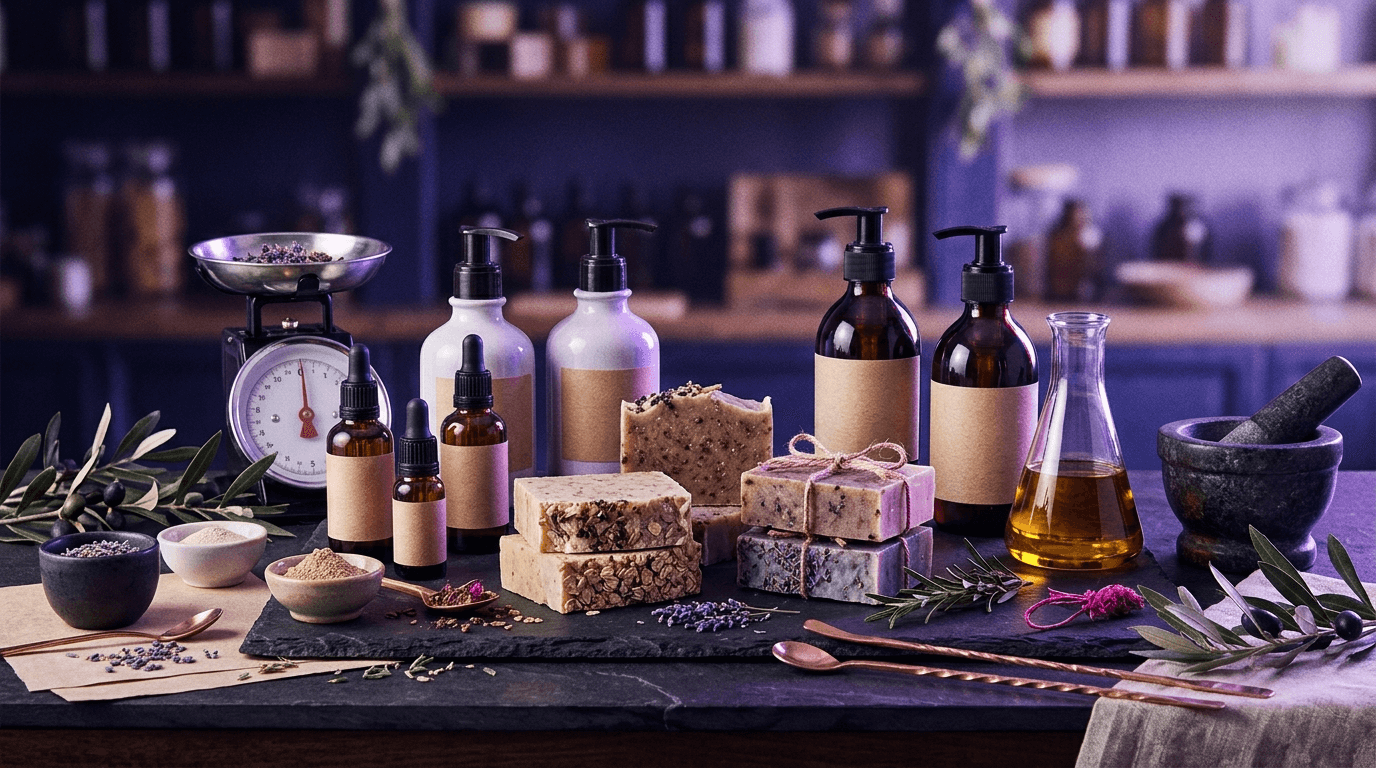
In workshops producing handmade natural soap, liquid hand soap, or herbal body oils, the sneakiest part of the cost hides in items outside the formula. A bottle of lavender liquid soap contains pure essential lavender oil priced just as high as olive oil and coconut oil. Moreover, when you add amber glass bottles, pump heads, water-resistant labels, and the waste left at the bottom of the filling tank, the cost per bottle goes well beyond just the raw material calculation.
While new orders come in every day on your e-commerce site and marketplaces, realizing that glass bottle or label stock has run out only while packing boxes disrupts sales. Meanwhile, launching campaigns in a market where oil and essence prices change regularly without knowing the current unit cost directly eats into your profit.
A Workshop-Friendly Recipe System Instead of Heavy Manufacturing Software
In a natural cosmetics workshop with two to ten employees, the production team simultaneously mixes formulas, handles filling, and packs shipments. Setting up heavy corporate systems for a business of this scale does not speed up operations; instead, it drowns you in screens. What you need is to save the formula recipe once, enter the number of successful bottles when bottling is complete, and automatically update all oil, essence, bottle, and label stocks.
The pre-accounting platform Qolay.App, with its Production Management add-on module, works with the same three screens on web and iOS/Android mobile: Recipes, Production Entries, and Reports. When packaging such as bottles and labels is defined as a Stock-type extra cost, it is both added to the cost during production entry and directly deducted from stock.
This way, the moment soap is poured or liquid is filled in the workshop, your oil, essence, pump head, and label stocks are updated to reality; the cost of the resulting products is calculated transparently with the remaining stock FIFO and nightly finalization engine.
Numerical Cost Table: 200 Units of Lavender Liquid Hand Soap (300 ml)
Let's consider our workshop making a production entry of 200 units for Lavender & Olive Oil Liquid Soap in a 300 ml Amber Bottle. The 1.5-liter olive oil equivalent loss remaining at the bottom of the tank and in the filling hose is recorded separately through the "Enter Waste" window.
| Cost Item | Record Type | Quantity / Rate | Unit Price | Total Amount |
|---|---|---|---|---|
| Cold Pressed Olive Oil | Raw Material Component | 30 liters (0.15 L × 200) | 320.00 TL | 9,600.00 TL |
| Coconut Saponification Base | Raw Material Component | 20 kg (0.10 kg × 200) | 210.00 TL | 4,200.00 TL |
| Pure Lavender Essential Oil (Essence) | Raw Material Component | 2 liters (0.01 L × 200) | 1,600.00 TL | 3,200.00 TL |
| Raw Material Subtotal | % Rate Base | - | - | 17,000.00 TL |
| Cold Pressed Olive Oil | Enter Waste (Tank/Filling) | 1.5 liters | 320.00 TL | 480.00 TL |
| 300 ml Amber Glass Bottle and Pump | Extra Cost (Stock) | 200 units (Multiplication Open) | 24.00 TL | 4,800.00 TL |
| Water-Resistant Front-Back Label | Extra Cost (Stock) | 200 units (Multiplication Open) | 5.00 TL | 1,000.00 TL |
| Heating Energy and Quality Test Share | Extra Cost (Service–Rate) | 10% (Raw Material Only) | - | 1,700.00 TL |
| Batch Filling and Labeling Labor | Extra Cost (Service–Amount) | 1 batch (Multiplication Closed) | 1,020.00 TL | 1,020.00 TL |
| Grand Total Cost | 17,000 + 480 + 8,520 | 200 units | Unit Cost: | 130.00 TL |
Here, the 10% energy and quality control expense is applied only to the 17,000.00 TL oil and essence subtotal; the 480.00 TL filling waste and the total 5,800.00 TL bottle and label stock extra costs are not included in the percentage base. When the total cost of 26,000.00 TL is divided by 200 sound bottles, the unit cost becomes 130.00 TL.
Step-by-Step Tracking in the Cosmetics Workshop with Qolay.App
- Recipes (Production → Recipes): Create a single recipe for each product. Enter oils and essences with decimals (e.g., 0.01 L) based on the litre or kg units in product cards; note that there is no unit conversion in the first version. When you add bottles, pumps, and labels in the Extra Costs tab with the Stock type, both items are automatically multiplied and deducted from stock.
- Production Entries and Enter Waste (Production → Production Entries): After the soap rests and is bottled, enter the number of sound bottles produced. If a special gift box was used in this batch, you can add a Stock extra cost specific only to that record while preserving the main recipe. Process tank bottom or broken bottle losses through the "Enter Waste" window.
- Marketplace Synchronization and Reports: When production is approved, oil, essence, bottle, and label stocks are deducted; 200 bottles of liquid soap enter stock, and the marketplace stock transfer automatically sees the new quantity. The nighttime FIFO engine calculates the exact cost. You can print the Production Slip PDF and check the profit margin according to the selling price using "Show margin" from the Recipe Cost report under Reports.
4 Common Cost Mistakes in Cosmetics Workshops
- Not Tracking Bottles, Pumps, and Labels Separately: These packaging items, which seem small in amount, can approach a third of the total cost; they must be defined as Stock extra costs.
- Neglecting Decimal Precision in Essential Oils: Failing to clearly write 10 ml of an expensive essence purchased in liters as 0.01 L in the recipe creates stock discrepancies.
- Ignoring Filling and Tank Losses: Not deducting the oil remaining in the tank in every batch with a separate Enter Waste record accumulates imaginary oil stock on paper.
- Skipping Bar Soap Base Directly: Moving on to the final recipe without first producing and stocking a pre-melted and prepared soap base as a semi-finished product disrupts stock.
- Launching Campaigns Without Updating Selling Price: Offering discounts when essential oil and glass bottle costs increase without checking the profit margin from the Recipe Cost report reduces earnings.
Frequently Asked Questions
Can I buy essence in grams or milliliters and write liters directly in the recipe?
There is no conversion between units in the first version. Therefore, it is best to open the essence product card in liters (0.01 L) or directly in milliliters according to the precision you use and use the same unit in the recipe.
Will production entry stop if my bottle stock drops below zero?
No. When stock is insufficient, the system gives a warning but allows you to save production. When you enter the purchase invoice, negative stock is corrected and the nighttime FIFO engine updates the cost.
Is the manufactured soap stock automatically updated in my e-commerce store?
Yes. When production entry is completed, finished product stock increases, and the marketplace or e-commerce stock transfer automatically sees the new stock.
Can I get a Production Slip printout for in-workshop records?
Yes. You can get a customizable Production Slip PDF printout for each production entry and review four different production reports with Excel export up to 366 days.
Conclusion: Transparent Cost in Your Natural Products
Sustainable growth in natural soap and cosmetics production depends on accurately tracking every gram and piece, from oil to essence and glass bottle to label. You can effortlessly manage your recipes and e-commerce stocks with Qolay.App Production Management. You can also check out our article on How to Calculate Product Cost regarding unit cost calculation.
Open a free account on Qolay.App and activate the Production Management module from Qolay Market with a trial period.
This article is for general informational purposes. It is recommended to consult relevant experts and your financial advisor for cosmetic production permits and financial legislation.
Try it after reading
Start applying what you read with Qolay.App — for free.
Related articles
Other guides close to this topic.
How to Track Project-Based Income-Expense, Budget, and Actual Profitability?
Seeing Which Job Is Profitable with Cost Center and Project Tagging
Discover which jobs make a profit and which cause a loss for your business with project-based income and expense tracking. Learn cost center and project tagging methods.
Seasonal Milk Price and Cost Tracking for Ice Cream and Dairy Dessert Manufacturers
Real-Time Monitoring of Milk Price Hikes, Boiling Loss, and Packaging Costs
Learn how to cost seasonal milk price hikes, pasteurization losses, and packaging containers with simple recipes in ice cream and dairy dessert production facilities.