

Granule Consumption, Burr Waste, and Energy Allocation in Small Plastic Injection Workshops
Manage PP/ABS granules, masterbatch pigment, machine electricity allocation, box-bag inventory, and runner-burr waste in small plastic injection workshops with Qolay.App.
On this page
There is More Than Just Granule in Every Injection Molding Print
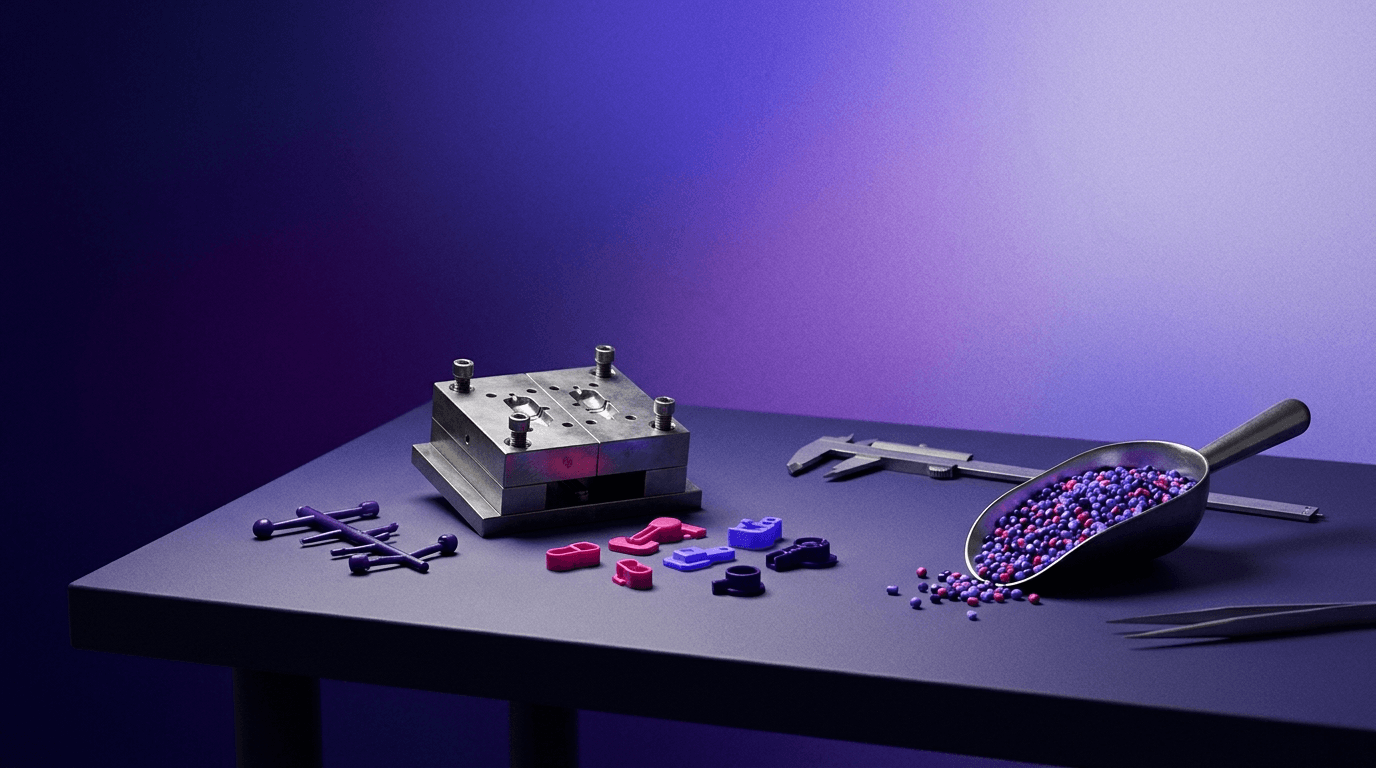
In small plastic injection workshops producing items like kitchen storage containers, electrical junction boxes, furniture fittings, or cosmetic caps, pricing is often calculated simply as: "the part weighs 80 grams, a kilo of granules costs 80 TL, therefore the part costs 6.40 TL." However, this rough calculation overlooks the workshop's top three cost sources.
First, color masterbatch additives are much more expensive than raw granules. Second, the injection machine's heating bands, hydraulic pump, and cooling chiller unit draw high amounts of electricity for hours. Third, the initial defective prints produced while the mold is warming up, along with burnt runners and flash waste that cannot go into the granulator, deplete the granule stock in every batch. When you add internal protective bags and operator labor to these, the actual unit cost rises rapidly.
Why Simple Recipes and Production Entries Instead of Heavy ERP and MRP?
ERP and MRP software built for large automotive sub-industry facilities are unnecessarily complex for SME workshops operating with 2–6 injection machines. Instead of setting up separate planning flows for every mold cavity and cycle time, a lean pre-accounting production setup synchronized with your purchase invoices yields results much faster.
Qolay.App is a pre-accounting platform. The web and iOS/Android mobile apps offer the same simple Production Management screens: You create a single recipe for each printed product, and when the printing batch is completed, you make a Production Entry in a single form. You record burnt granules and unusable flash spilled at the start of the mold run using the Enter Waste window.
Realistic Scenario: 500 Units of 500 ml Screw-Top PP Storage Containers
Let's assume that 500 units of 500 ml Screw-Top PP Storage Containers are printed as a batch in the workshop. The unrecoverable 2.00 kg PP granule waste during the mold warm-up stage and initial trial prints has been deducted via Enter Waste:
| Cost Item (For 500 Units) | Record Type | Quantity / Calculation | Amount (TL) |
|---|---|---|---|
| PP (Polypropylene) Raw Granules | Component | 500 × 0.08 kg = 40.00 kg × 80 TL | 3,200.00 TL |
| White Masterbatch Color Additive | Component | 500 × 0.004 kg = 2.00 kg × 250 TL | 500.00 TL |
| Raw Material Total | Subtotal | 3,200 + 500 | 3,700.00 TL |
| Injection Machine & Chiller Electricity | Extra Cost (Service–Rate) | Raw material only (3,700 TL) × 20% | 740.00 TL |
| Mold Mounting & Operator Labor | Extra Cost (Service–Amount) | Fixed per batch (multiplication off) | 1,000.00 TL |
| Inner Protection Bag + Shipping Label | Extra Cost (Stock) | 500 units × 2 TL (multiplication on) | 1,000.00 TL |
| Mold Warm-Up & Burnt Runner Waste | Enter Waste | 2.00 kg PP Granules × 80 TL (not included in 20% base) | 160.00 TL |
| Total Production Cost | Grand Total | 3,700 + 160 + (740 + 1,000 + 1,000) | 6,600.00 TL |
| Unit Part Cost | 500 Good Units | 6,600.00 ÷ 500 | 13.20 TL / unit |
While the PP granule cost alone appears as 6.40 TL per part, when masterbatch, the 20% machine electricity share (740 TL), mold mounting and operator labor (1,000 TL), bag and label (1,000 TL), and 160 TL runner waste are added, the actual unit cost climbs to 13.20 TL. In workshops with frequent mold and color changes, seeing all these items in a single table directly improves your quote quality.
Step-by-Step Tracking in the Injection Workshop with Qolay.App
- 1. Set Up the Recipe (Production → Recipes): Define PP/ABS granules and masterbatch dye as components using the exact same unit (kg) as on the purchase invoice. Add the electricity share as Service–Rate (%), mold mounting/operator fee as Service–Amount, and bags and boxes as Stock extra costs.
- 2. Record the Print Batch (Production → Production Entries): Make the production entry when 500 good parts are printed and bagged. Record burnt granules and faulty initial prints that cannot be recycled in the machine via the Enter Waste window.
- 3. Manage Multi-Part Lid-Body Assembly: If you print the body and lid in separate molds and then assemble them, you first produce the body and lid like semi-finished products and then make a production entry by combining them in the "Set Storage Container" recipe.
- 4. Pull Consumption and Margin Reports (Production → Reports): Monitor your monthly granule consumption with the Raw Material Consumption report; audit your wholesale price lists with the "Show margin" toggle in the Recipe Cost report. You can export all reports in Excel format with a maximum interval of 366 days.
5 Common Cost Mistakes in Plastic Injection Workshops
- Neglecting Masterbatch Dye Costs: Color pigments or UV additives mixed in at a 3–5% rate can reach up to 15% of the total raw material cost due to their high unit prices.
- Not Distributing Mold Mounting and Cleaning Labor Across Low Runs: While mold mounting adds 2 TL per piece on a small order of 500 units, it adds 0.20 TL on a 5,000-unit batch; the per-batch Service–Amount automatically balances this out.
- Entering a 25 kg Bag as "Units" and Trying to Consume it as "Kg" in the Recipe: There is no unit conversion in v1; it is mandatory to enter purchase invoices directly in kilograms (kg).
- Failing to Deduct Unrecovered Flash and Machine Cleaning Waste: If you don't enter waste, it looks like there are tons of granules in the warehouse, leading to raw material shortages during urgent orders.
- Giving Price Quotes Without Entering Granule Purchase Invoices: If the purchase invoice is missing, you may see a "No cost" (0 TL) warning in the recipe; it is essential to process all supplier invoices up to date.
Frequently Asked Questions
Should I enter waste if I pass runners through a granulator and reuse them?
You do not deduct good runners that are re-granulated and returned to production as waste. You only deduct unrecoverable granules that go completely to waste during color transitions, machine cleaning, or as a result of burning, using Enter Waste.
How can I document the cost summary to a customer for whom I do contract printing?
You can get a customizable Production Slip PDF output from the production record or export the Production Summary and Raw Material Consumption tables for the relevant period as Excel from the Reports screen.
When is the new production cost finalized when granule import prices increase?
When you enter your new granule purchase invoice, the cost sequence in the recipe is updated immediately according to FIFO and the latest purchase; the FIFO engine running at night after the production entry also finalizes the batch cost.
If I subsequently correct an incorrectly entered print quantity, is the granule stock updated?
Yes. When you edit or delete the relevant record on the Production Entries screen, granule, masterbatch, bag, and finished product stock movements are updated automatically.
Turn Every Printing Cycle Into Profitability
Regularly monitoring granules, masterbatch, electricity shares, and mold waste in small plastic injection workshops reduces the margin of error in your quotes to zero. For details, you can review the Qolay.App Production Management page; you can also read our articles on How Production Costs Are Finalized with FIFO Cost Logic and Reflecting Labor, Energy, and Packaging into Unit Costs. The Production Management module is offered as a separate add-on in Qolay Market with an open trial period. Take control of your workshop costs right away by opening a free account on Qolay.App.
This article is for general informational purposes. Consult your financial advisor for VAT and withholding tax applications regarding scrap/flash sales in the plastics industry.
Try it after reading
Start applying what you read with Qolay.App — for free.
Related articles
Other guides close to this topic.

Paper, Binding, and Cover Costs for Boutique Notebook, Planner, and Stationery Manufacturers
Unit Cost of Interior Paper, Hard Cardboard Cover, Spiral Wire, and Guillotine Waste
Calculate interior paper, cover cardboard, spiral wire, printing labor, and guillotine cutting waste with Qolay.App in boutique notebook, planner, and agenda workshops.
Seasonal Milk Price and Cost Tracking for Ice Cream and Dairy Dessert Manufacturers
Real-Time Monitoring of Milk Price Hikes, Boiling Loss, and Packaging Costs
Learn how to cost seasonal milk price hikes, pasteurization losses, and packaging containers with simple recipes in ice cream and dairy dessert production facilities.
Raw Material and Pail Costs in Small Paint and Construction Chemical Mixing Businesses
Tracking Resins, Pigments, Mixing Tank Residue Waste, and Plastic Pails
Learn how to track the costs of acrylic resin, fillers, pigments, mixing tank residue waste, and plastic pails in small paint and construction chemical mixing workshops using simple pre-accounting.