

Food Cost and Packaging Expense Tracking in Cloud Kitchens (Ghost Kitchens)
Manage semi-finished sauces, recipe formulas, leak-proof takeout containers, and kitchen waste in cloud kitchen (ghost kitchen) businesses with Qolay.App.
On this page
The Invisible Profit Leak in Ghost Kitchens: Packaging and Prep Waste
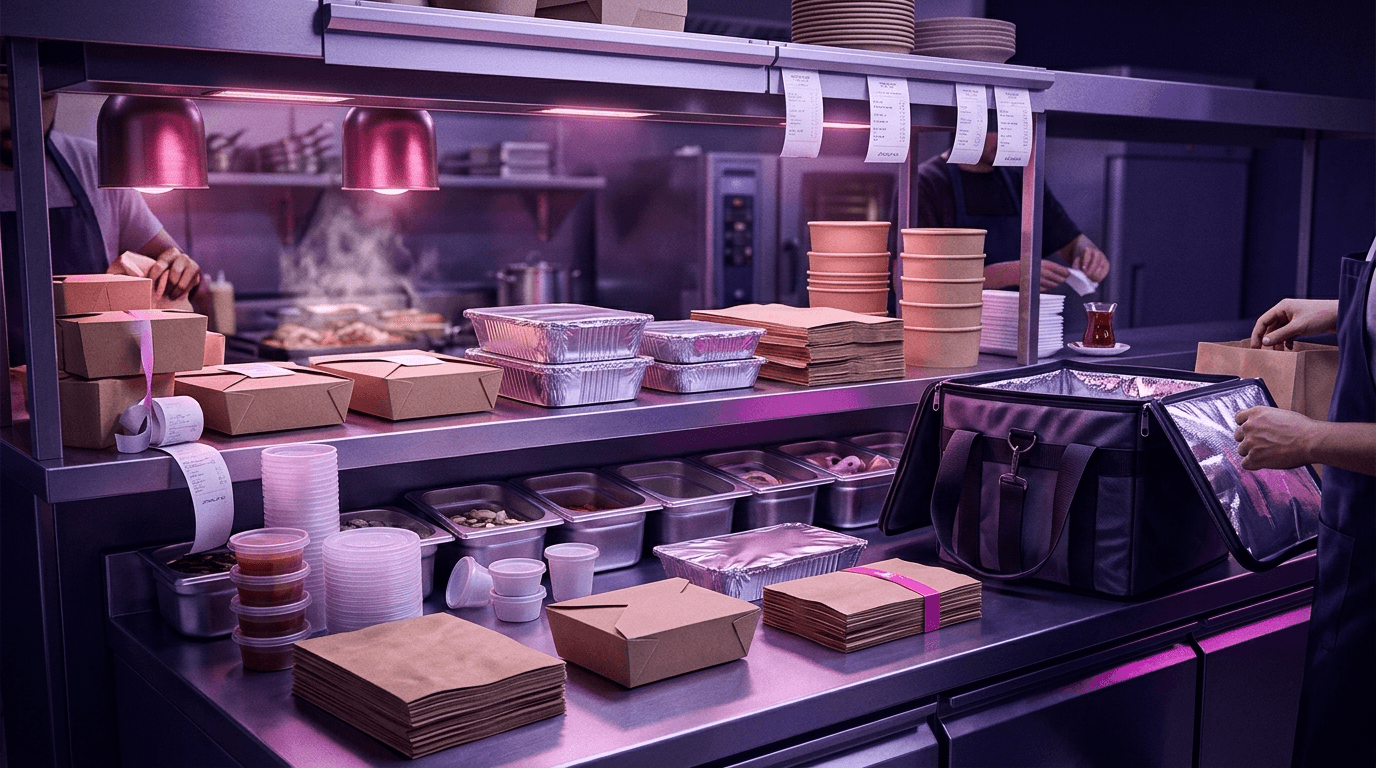
Ghost kitchens operating solely through delivery channels do not incur dine-in service expenses; however, this does not mean cost control is easy. On the contrary, fulfilling all orders with cardboard bowls, leak-proof lids, fork-and-napkin sets, wet wipes, and carry bags turns packaging expenses into the fastest-growing item in portion costs.
In addition, ghost kitchens can produce multiple virtual brands or menu groups under the same roof. Special sauces and boiled base products (semi-finished goods) prepared in pots in the morning are distributed into various bowls and wraps throughout the day. If you fail to log these semi-finished goods, packaging boxes, and vegetable-meat trimming waste, you won't be able to see your net profit at the end of the month, despite heavy order traffic on food delivery platforms.
Why Simple Recipes and Production Entries Instead of Heavy ERP and MRP?
Large-scale enterprise ERP or MRP systems are overly heavy for fast-paced delivery kitchens. Kitchen staff cannot fill out approval flows or complex planning tables for every station during the day. What you need is an accounting setup that directly communicates with your purchase invoices, and practically records semi-finished sauces and portion production.
Qolay.App is an accounting platform, not a large-scale enterprise ERP system. The web and iOS/Android mobile apps offer the exact same simple Production Management screens. You first take the semi-finished sauce into stock with its own production entry; then, at the end-of-day service closing, you easily record the number of completed bowls produced, packaging stock deductions, and resulting kitchen waste in a single form.
Realistic Scenario: Cost of 80 Portions of Grilled Chicken Quinoa Bowl
Let's assume a production entry is made for the output of 80 portions of Grilled Chicken Quinoa Bowl at the end of the day in your ghost kitchen. First, the semi-finished good Tahini Lemon Sauce (kg) was produced in the kitchen and taken into stock at a cost of 300 TL per kilogram. All portion, box, and waste costs are calculated in the table below:
| Cost Item (For 80 Portions) | Record Type | Quantity / Calculation | Amount (TL) |
|---|---|---|---|
| Marinated Chicken Breast | Component | 80 × 0.18 kg = 14.40 kg × 250 TL | 3,600.00 TL |
| Boiled Quinoa & Rice Mix | Component | 80 × 0.15 kg = 12.00 kg × 100 TL | 1,200.00 TL |
| Seasonal Veggies & Avocado | Component | 80 × 0.10 kg = 8.00 kg × 125 TL | 1,000.00 TL |
| Tahini Lemon Sauce (Semi-Finished) | Component | 80 × 0.05 kg = 4.00 kg × 300 TL | 1,200.00 TL |
| Raw Material Total | Subtotal | 3,600 + 1,200 + 1,000 + 1,200 | 7,000.00 TL |
| Grill & Cooling Energy Share | Extra Cost (Service–Rate) | Raw material only (7,000 TL) × 10% | 700.00 TL |
| Chef & Packaging Prep Share | Extra Cost (Service–Amount) | Fixed per batch (multiplication off) | 600.00 TL |
| Leak-Proof Kraft Bowl + Lid + Set | Extra Cost (Stock) | 80 pcs × 18 TL (multiplication on) | 1,440.00 TL |
| Grilled Burnt Chicken (Waste 1) | Enter Waste | 0.80 kg × 250 TL (not included in 10% base) | 200.00 TL |
| Veggie Trimming Residue (Waste 2) | Enter Waste | 0.48 kg × 125 TL (not included in 10% base) | 60.00 TL |
| Total Production Cost | Grand Total | 7,000 + 260 + (700 + 600 + 1,440) | 10,000.00 TL |
| Unit Portion Cost | 80 Portions Completed | 10,000.00 ÷ 80 | 125.00 TL / pc |
As seen, while the internal ingredients total alone is 87.50 TL per portion, adding the leak-proof packaging box (18 TL), energy (10% = 700 TL), prep labor, and 260 TL kitchen waste brings the actual unit cost to 125.00 TL. You must set your menu price and food platform campaigns strictly based on this net cost.
Step-by-Step Implementation in a Ghost Kitchen with Qolay.App
- 1. Set Up Semi-Finished and Menu Recipes (Production → Recipes): First, define sauces used across multiple menus, such as Tahini Lemon Sauce, as semi-finished recipes. Then, link components, the 10% energy rate, fixed labor, and the Stock-type packaging set to the bowl and salad recipes.
- 2. Enter Sauce First, Then Portion (Production → Production Entries): Since there is no automatic sub-production, enter the semi-finished production when the sauce is prepared; at service closing, record the 80-portion bowl entry from the web or mobile app.
- 3. Process Kitchen Losses Separately (Enter Waste): Record dried chicken on the grill and vegetable trimming residues via the Enter Waste window. The consumption line remains intact, stocks drop realistically, and the waste amount reflects in the cost without inflating the rate base.
- 4. Monitor Margin and Consumption (Production → Reports): After the night-time FIFO engine finalizes costs, open the "Show margin" option in the Recipe Cost report to check your selling prices on food platforms. Plan your weekly purchasing with the Raw Material Consumption and Waste Report.
5 Frequent Cost Mistakes in Ghost Kitchens
- Treating Leak-Proof Containers and Sauce Bowls as General Expenses: If lids, sauce cups, and bowls sent with every order are not deducted from stock, profitability looks high on paper, but the packaging storage depletes suddenly.
- Calculating Sauces with Estimated Costs Without Recipes: If olive oil or tahini prices go up and there is no semi-finished recipe, the main dish cost is not updated.
- Ignoring Fresh Vegetable Peeling Waste: Trimming losses are high in avocados, greens, and root vegetables; if Enter Waste is not used, kitchen counts will constantly show shortages.
- Forgetting to Add Platform Commission to Kitchen Cost: Putting a bowl costing 125 TL on discount without calculating platform commission and courier share creates sales at a loss.
- Not Matching Stock Units with Purchase Invoices: Since there is no unit conversion in the first version, you need to track chicken and vegetable purchases over the same unit (kg) in the recipe.
Frequently Asked Questions
How should I manage if I use the same sauce in 3 different bowl menus?
You create the sauce as a single semi-finished card and recipe. When the sauce pot is prepared, you take it into stock via a production entry; all 3 different bowl recipes consume from this single sauce stock as a component.
Do I need to change the main recipe if an extra cardboard carry bag is given with an order?
No. You can add an extra cost line specific to that record on the Production Entries screen or edit the existing line; your main recipe remains intact.
Can the kitchen staff enter records from their phones at the end of the day?
Yes. Authorized standard kitchen managers can make production and waste entries from the Qolay.App iOS or Android mobile app, while users with Accountant authority can review reports and the Production Slip PDF.
Protect Your Delivery Profit Starting from the Kitchen
In ghost kitchen operations, knowing the true cost and packaging expense of every portion is just as important as speed. For details, you can check out the Qolay.App Production Management page, and read our articles on Yemeksepeti, Getir, and Trendyol Food Accounting and Restaurant and Cafe Accounting Cost Control. The Production Management module is offered as a separate add-on in Qolay Market with an open trial period. Take control of your kitchen costs right away by opening a free account on Qolay.App.
This article is for general informational purposes. Consult your financial advisor regarding food VAT rates, e-receipts, and platform commission accounting.
Try it after reading
Start applying what you read with Qolay.App — for free.
Related articles
Other guides close to this topic.

What to Do If Raw Material Stock Drops to Negative During Production Entry?
Invoice Delay, Opening Stock, and Nighttime FIFO Cost Correction
Learn how to continue your workflow without locking it when raw materials drop to negative stock during production entry, and how to fix it using purchase invoices and the nighttime FIFO engine.

Slab Consumption, Breakage Waste, and Cost in Marble and Natural Stone Workshops
Net Unit Cost in Kitchen Countertop and Tabletop Production
Calculate slab square meter consumption, cutting breakage waste, and labor costs in marble and natural stone workshops with a simple basic accounting workflow.